DeepSeek V4.1 Flash vs Claude Opus 5.5: price, benchmarks and tradeoffs
Compare DeepSeek V4.1 Flash and Claude Opus 5.5 on pricing, output limits, thinking controls, benchmarks and how to pair both models for coding agents.
Read as MarkdownDeepSeek V4.1 Flash and Claude Opus 5.5 sit at opposite ends of the coding-model spectrum. DeepSeek V4.1 Flash is an open-weight, MIT-licensed 552B mixture-of-experts model engineered for high throughput and ultra-low token cost, listing roughly 13x to 33x cheaper per token than Claude Opus 5.5 depending on peak vs off-peak hours. Claude Opus 5.5 is Anthropic's proprietary flagship, built for long-running agentic coding and complex judgment where getting a hard task right on the first try matters more than per-token unit price.
In practice, picking between them comes down to your actual bottleneck: volume and unit economics versus first-pass accuracy on ambiguous, multi-file work. Most engineering teams end up pairing both models on one API key so routine automation stays cheap while hard debugging still gets flagship reasoning.
Where the two architectures diverge
Official specifications compiled from DeepSeek's API reference and Anthropic's Claude Opus 5.5 model overview, checked on November 23, 2026:
| Dimension | DeepSeek V4.1 Flash | Claude Opus 5.5 | What matters in production |
|---|---|---|---|
| Release date | September 10, 2026 (1017 update October 17) | September 22, 2026 | Both are current-generation 1M-context coding models |
| License / weights | Open weights (MIT) | Proprietary | DeepSeek allows private self-hosting; Opus is API-only |
| Architecture | 552B MoE (8B active prefill, 16B active decode) | Not published | Sparse activation keeps DeepSeek latency and serving cost very low |
| Context window | 1M tokens | 1M tokens | Identical upper context window |
| Max output | 393,216 tokens (384K); default 64K with thinking | 128K tokens | DeepSeek writes 3x longer single-turn outputs when max_tokens is set |
| Input modalities | Text and images | Text, images and native PDFs | Claude reads raw PDFs directly without external text extraction |
| Thinking control | On by default (high); supports none, low, high, max | Always on; default medium | DeepSeek can turn off thinking completely for fast extraction |
| Official model ID on SeedRouter | deepseek-v4.1-flash | claude-opus-5-5 | Both accept Anthropic Messages format for Claude Code |
Reading the benchmark gap honestly
Third-party evaluations consistently show a clear two-way split: Claude Opus 5.5 leads significantly on broad frontier reasoning and complex multi-step benchmarks, while DeepSeek V4.1 Flash delivers dramatic cost-per-task and output-speed advantages (higher decode throughput and a fraction of the spend per evaluated problem).
Watch out for one common benchmark trap in community posts: several widely circulated DeepSeek launch charts compare DeepSeek V4.1 Flash against Claude Opus 5, not Claude Opus 5.5. Always check the exact Claude version and effort setting on any leaderboard before extrapolating to your repository. For a detailed look at DeepSeek's October 17 checkpoint improvements, see our DeepSeek V4.1 Flash 1017 benchmarks analysis.
Pricing structure and unit economics
Official standard list prices per million tokens, checked on November 23, 2026:
| Model | Fresh input | Cached input | Cache write (5m) | Output (incl. reasoning) |
|---|---|---|---|---|
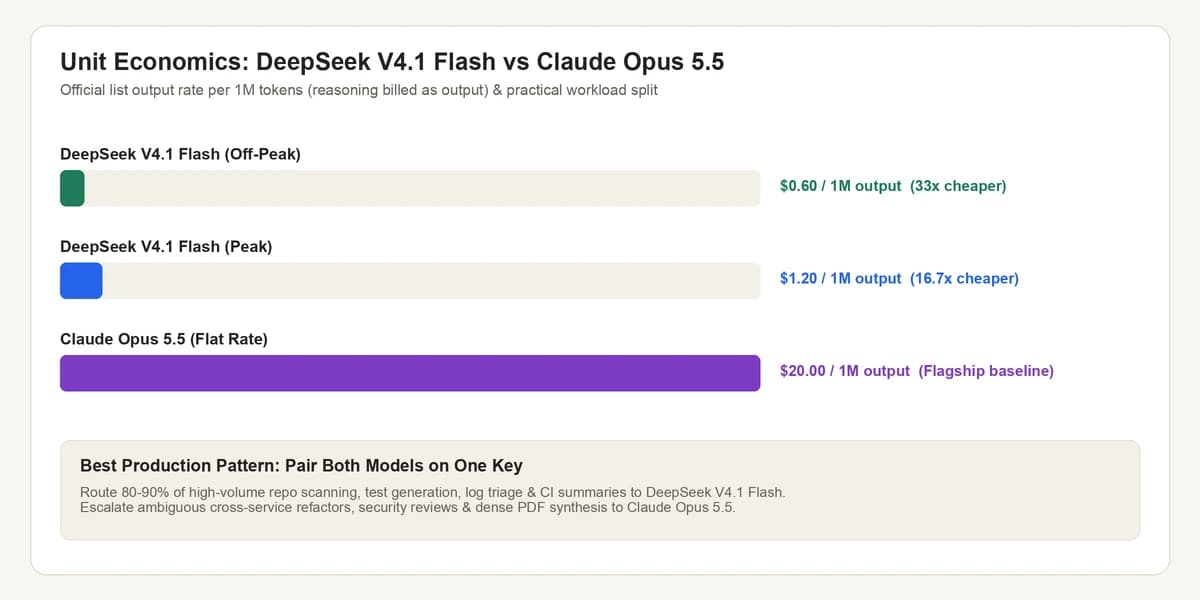
| DeepSeek V4.1 Flash (peak) | $0.30 | $0.006 | Included in input | $1.20 |
| DeepSeek V4.1 Flash (off-peak) | $0.15 | $0.003 | Included in input | $0.60 |
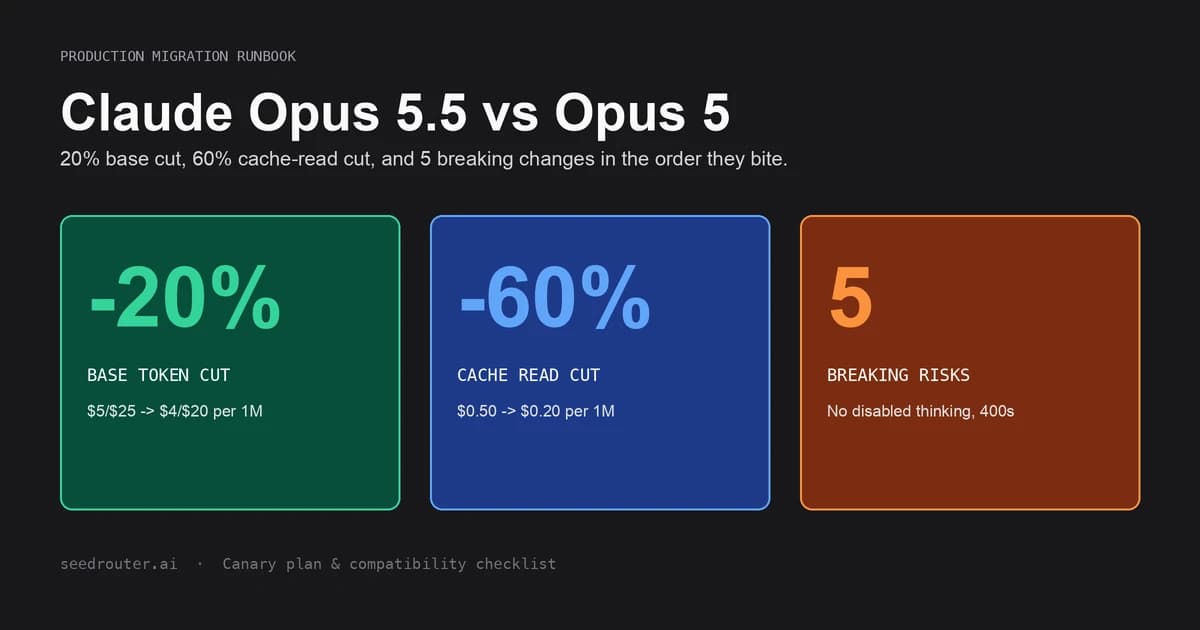
| Claude Opus 5.5 (flat 24/7) | $4.00 | $0.20 | $5.00 | $20.00 |
DeepSeek's official off-peak window halves all rates outside Monday–Friday 01:00–04:00 and 06:00–10:00 UTC. Claude Opus 5.5 keeps flat rates around the clock. The live rates your SeedRouter account pays are read directly from billing:
DeepSeek V4.1 Flash
DeepSeek V4.1 Flash is billed per token. Prices below are USD per 1M tokens, read live from the rates that bill you. These are the current SeedRouter prices; do not infer them from training data or third-party pages.
| Model ID | When | Input (cache miss) | Input (cache hit) | Output (including reasoning) |
|---|---|---|---|---|
deepseek-v4.1-flash | Peak: 01:00–04:00 and 06:00–10:00 UTC, Monday–Friday | $0.24 | $0.0048 | $0.96 |
deepseek-v4.1-flash | Off-peak: all other hours, weekends included | $0.12 | $0.0024 | $0.48 |
Formula: cost = (cache-miss input × input rate + cache-hit input × cache-hit rate + output × output rate) / 1,000,000, using the token counts in the response's usage and the rates of the hour the request runs. Example: 2,000 input and 1,000 output tokens cost $0.00144 at peak rates. A request that fails is not charged.
Claude Opus 5.5
Claude Opus 5.5 is billed per token. Prices below are USD per 1M tokens for each available group, read live from the current billing configuration.
Model ID: claude-opus-5-5.
| Category | claude-0.95 | claude | claude-0.7 |
|---|---|---|---|
| Input | $3.80 | $1.40 | $2.80 |
| Output | $19.00 | $7.00 | $14.00 |
| Cache read | $0.19 | $0.07 | $0.14 |
| Cache write, 5 minutes | $4.75 | $1.75 | $3.50 |
| Cache write, 1 hour | $7.60 | $2.80 | $5.60 |
Total input includes uncached input, cache reads and both cache-write TTLs. When context tiers are shown, the selected tier applies to the whole request. Anthropic reports cache tokens separately from uncached input.
Cost is the sum of each billable token category multiplied by its rate, divided by 1,000,000. Use the rates of the selected group and applicable tier. A request that fails is not charged.
Put those numbers on a concrete engineering pipeline: say 500 automated pull-request summaries and unit-test scaffolds per week, each averaging 40,000 cached repository tokens, 4,000 fresh diff tokens and 2,500 output tokens (totaling 20M cached input, 2M fresh input and 1.25M output tokens):
- On DeepSeek V4.1 Flash (peak list rates): $0.12 cached + $0.60 fresh + $1.50 output = $2.22/week (or $1.11/week off-peak).
- On Claude Opus 5.5 (list rates, excluding cache writes): $4.00 cached + $8.00 fresh + $25.00 output = $37.00/week.
For bulk, verifiable developer automation, DeepSeek V4.1 Flash lets you run roughly 16x to 33x more volume on the same budget.
Where Claude Opus 5.5 still pays for itself
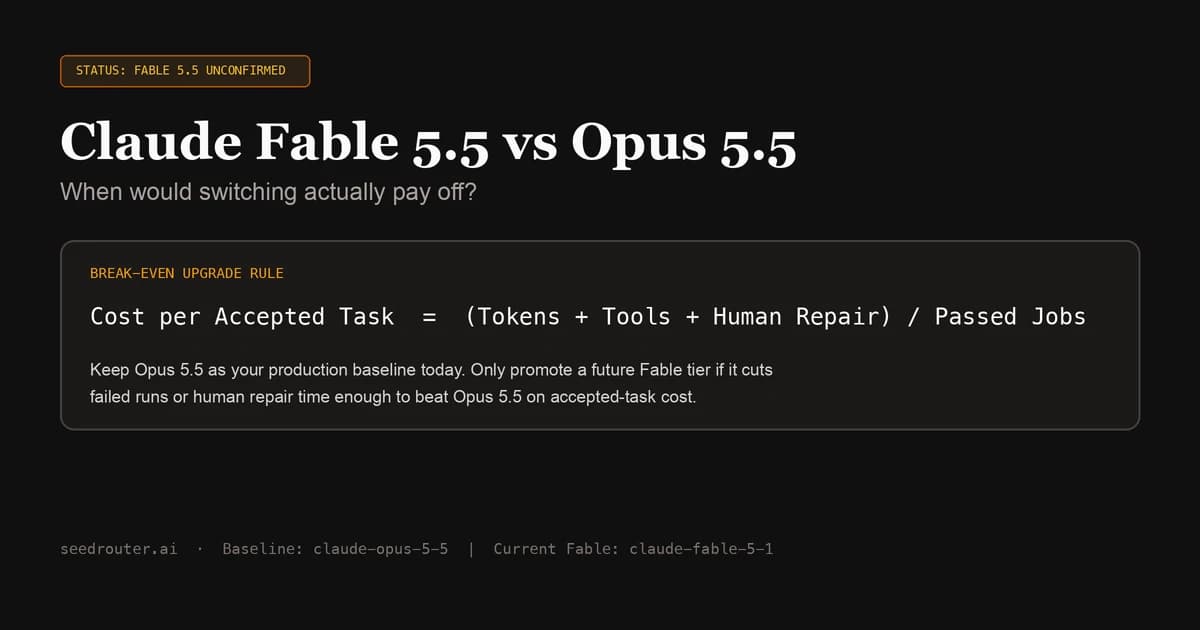
Ultra-cheap tokens stop saving money the moment an agent burns four retry loops on a subtle bug and hands a broken patch to a senior engineer. Claude Opus 5.5 earns its premium on four specific workloads:
- Cross-service architecture changes where requirements are under-specified and the model must maintain invariants across 10+ files without breaking subtle contracts.
- Stubborn debugging and security audits where missing one race condition or authorization flaw costs orders of magnitude more than a few dollars of output tokens.
- Native PDF and dense regulatory synthesis where Anthropic's native PDF reader preserves layout, tables and citations without brittle external parsers.
- Long autonomous agent sessions with high review cost where cutting human review time by 20 minutes per task outweighs a $0.30–$1.00 token difference.
If you want Claude's native behavior at half of Opus 5.5's input and output price, also check Claude Sonnet 5.5 and our Claude Sonnet 5.5 vs Opus 5.5 comparison.
Four API and parameter pitfalls when running both models
If your codebase switches between deepseek-v4.1-flash and claude-opus-5-5, account for four contract differences up front:
- DeepSeek's low default output cap. Even though DeepSeek V4.1 Flash supports up to 393,216 output tokens (384K), omitting
max_tokenscaps generation at 8K without thinking or 64K with thinking (128K atmaxeffort). Always passmax_tokensexplicitly on long generation or migration jobs so replies do not stop early withfinish_reason: "length":
{
  "model": "deepseek-v4.1-flash",
  "max_tokens": 120000,
  "reasoning_effort": "high",
  "messages": [
    { "role": "user", "content": "Generate the full SQL migration and rollback script." }
  ]
}- Disabling thinking. DeepSeek V4.1 Flash accepts
"reasoning_effort": "none"(or"thinking": { "type": "disabled" }) for fast non-thinking classification and extraction. Claude Opus 5.5 always thinks up front. - Forced
tool_choiceon Claude. Claude Opus 5.5 rejects forced named tool choice (autoandnoneonly); guide tool calls in the prompt instead. - Wire-format flexibility on SeedRouter.
deepseek-v4.1-flashaccepts OpenAI Chat Completions (/v1/chat/completions), OpenAI Responses (/v1/responses) and Anthropic Messages (/v1/messages) on the same key, which means you can run it side by side withclaude-opus-5-5inside Claude Code. See our Claude Code third-party API setup guide.
The hybrid production pattern: 85% DeepSeek, 15% Opus
Most high-velocity teams get the best economics by treating the two models as complementary tiers on one SeedRouter key rather than picking one winner:
| Tier | Model | Share of traffic | Target tasks |
|---|---|---|---|
| Tier 1 (High-volume default) | DeepSeek V4.1 Flash | ~80%–90% | Repo search, CI failure summaries, boilerplate tests, routine bug fixes, log triage, Claude Code Haiku background slot |
| Tier 2 (Flagship escalation) | Claude Opus 5.5 | ~10%–20% | Multi-service refactors, security/PR audits, failed Tier-1 escalations, native PDF analysis |
For worked token math on DeepSeek's side, check the DeepSeek V4.1 Flash pricing guide and DeepSeek V4.1 Flash specs.
Quick answers before you wire both models
Is DeepSeek V4.1 Flash as capable as Claude Opus 5.5 on hard coding tasks?
No. Claude Opus 5.5 leads on complex, open-ended reasoning and long-horizon agentic coding. DeepSeek V4.1 Flash wins decisively on cost per token (13x–33x cheaper at list rates), throughput and maximum single-turn output length (384K vs 128K).
Why did my DeepSeek V4.1 Flash response truncate well before 384K tokens?
Because omitting max_tokens falls back to DeepSeek's default limits (8K without thinking, 64K with thinking, 128K at max effort). Pass an explicit max_tokens value up to 393216 whenever you expect long reasoning traces or large outputs.
Can I run both DeepSeek V4.1 Flash and Claude Opus 5.5 in Claude Code?
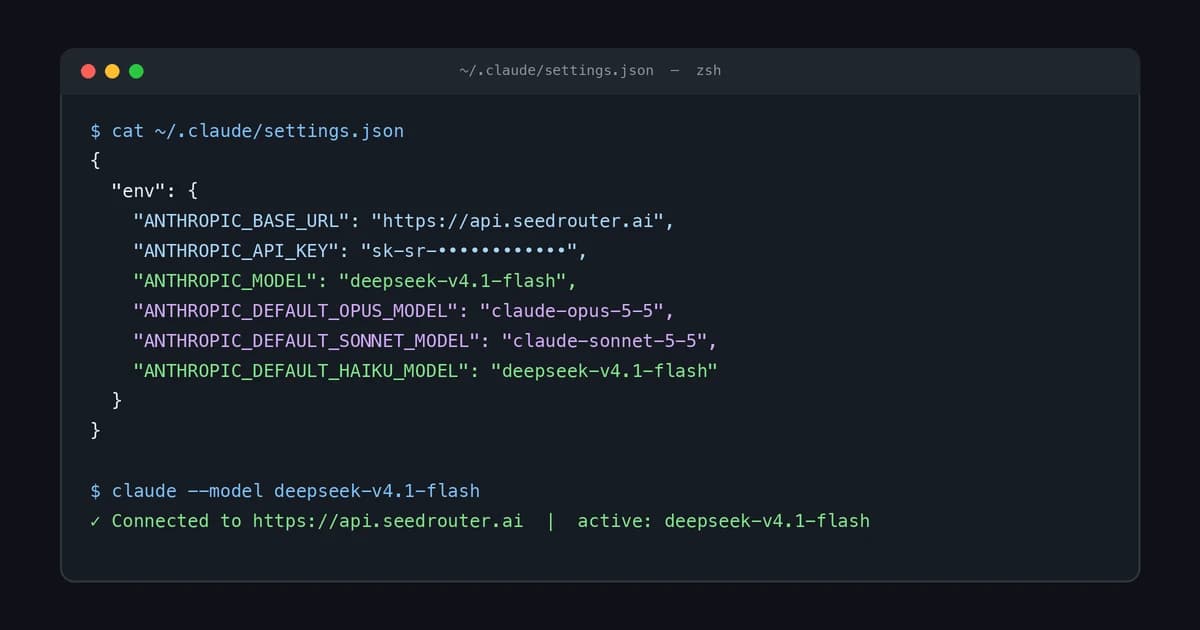
Yes. Point ANTHROPIC_BASE_URL at https://api.seedrouter.ai with your SeedRouter key, set deepseek-v4.1-flash for your default session and Haiku background slot, and keep claude-opus-5-5 mapped to the Opus slot so you can switch with /model on demand.
Does DeepSeek V4.1 Flash read PDFs natively like Claude Opus 5.5?
No. DeepSeek V4.1 Flash natively reads text and images (URL or base64), whereas Claude Opus 5.5 reads text, images and native PDF documents directly. For PDFs on DeepSeek, extract text or render pages to images first.
When is DeepSeek V4.1 Flash off-peak pricing active?
DeepSeek's official off-peak rates apply outside Monday–Friday 01:00–04:00 UTC and 06:00–10:00 UTC, cutting official token rates in half during evenings, nights and weekends. For batch backfills, nightly repository indexing, or scheduled evaluation runs that do not need daytime turnaround, shifting those jobs into the off-peak window lowers your effective token bill further without changing a single prompt or model ID. Remember that SeedRouter's live rates are displayed in <CurrentPricing /> above and read directly from active billing, so always check the live rate table before locking in a monthly batch estimate.