Claude Opus 5.5 vs Claude Opus 5: price cuts, breaking risks and upgrade plan
Claude Opus 5.5 vs Opus 5 for production teams: 20% base cut, 60% cache-read cut, five breaking compatibility changes, six test scenarios and a canary plan.
Read as MarkdownIf your production app already runs on Claude Opus 5 (claude-opus-5), upgrading to Claude Opus 5.5 (claude-opus-5-5, released September 22, 2026) looks like an obvious win on paper: Anthropic cut standard input and output prices by 20%, slashed cache-read pricing by 60%, and positioned Opus 5.5 as matching Claude Fable 5.1 on most work while costing roughly 40% less to run than Opus 5.
In production codebases, though, Opus 5.5 is not a zero-risk model-ID swap. Five concrete compatibility changes can break working Opus 5 clients with HTTP 400 errors, silently shift token spend, or make streaming progress text vanish from your UI. Whether the upgrade saves you money on day one depends on which request features your current client uses.
Decide your upgrade order from your current workload
Before changing any model string, match your current Opus 5 deployment against the six workload profiles below:
| Current Opus 5 workload | Recommended move | Why |
|---|---|---|
| Cache-heavy coding or document agent with large stable prefix | Prioritize pilot immediately | Cache reads drop 60% ($0.50 to $0.20 per M tokens) |
App sending thinking: { type: "disabled" }, budget_tokens, or forced tool_choice | Refactor client first, then pilot | All three patterns return HTTP 400 on Opus 5.5 |
| Streaming UI displaying progress text between tool calls | Update block renderer before rollout | Progress text moves into thinking blocks, hidden by default |
| Multi-tier fallback chain dropping from Opus to older Sonnet/Haiku mid-conversation | Retest escalation and handoff paths | Only Fable 5.1 and Mythos 5.1 can read Opus 5.5 thinking blocks |
| Latency-sensitive route that turned thinking off for speed | Benchmark Opus 5.5 at low effort against Opus 5 non-thinking | Thinking cannot be disabled on Opus 5.5; effort is your only lever |
| Stable legacy workflow with tight sprint bandwidth | Stay on Opus 5 until migration fixes land | Avoid mixing client rewrites with model quality evaluations |
What Anthropic actually changed between Opus 5 and Opus 5.5
Contract comparison compiled from Anthropic's official release notes, pricing tables, and Claude Opus 5.5 model overview, checked on November 23, 2026:
| Dimension | Claude Opus 5 | Claude Opus 5.5 |
|---|---|---|
| Release date | July 24, 2026 | September 22, 2026 |
| Official API ID | claude-opus-5 | claude-opus-5-5 |
| Context / max output | 1M / 128K tokens | 1M / 128K tokens |
| Standard input / output | $5.00 / $25.00 per M tokens | $4.00 / $20.00 per M tokens (-20%) |
| Cache write (5m / 1h) | $6.25 / $10.00 per M tokens | $5.00 / $8.00 per M tokens (-20%) |
| Cache read | $0.50 per M tokens (10% of input) | $0.20 per M tokens (5% of input, -60%) |
| Batch API input / output | $2.50 / $12.50 per M tokens | $2.00 / $10.00 per M tokens (-20%) |
| Thinking control | On by default; disabled allowed at high or below | Always on; disabled and budget_tokens return HTTP 400 |
| Default effort | Higher default on many legacy configs | medium |
Forced tool_choice | Supported on legacy patterns | Rejected (auto and none only) |
Live rates for claude-opus-5-5 on SeedRouter are read directly from billing:
Claude Opus 5.5
Claude Opus 5.5 is billed per token. Prices below are USD per 1M tokens for each available group, read live from the current billing configuration.
Model ID: claude-opus-5-5.
| Category | claude-0.95 | claude | claude-0.7 |
|---|---|---|---|
| Input | $3.80 | $1.40 | $2.80 |
| Output | $19.00 | $7.00 | $14.00 |
| Cache read | $0.19 | $0.07 | $0.14 |
| Cache write, 5 minutes | $4.75 | $1.75 | $3.50 |
| Cache write, 1 hour | $7.60 | $2.80 | $5.60 |
Total input includes uncached input, cache reads and both cache-write TTLs. When context tiers are shown, the selected tier applies to the whole request. Anthropic reports cache tokens separately from uncached input.
Cost is the sum of each billable token category multiplied by its rate, divided by 1,000,000. Use the rates of the selected group and applicable tier. A request that fails is not charged.
Sorting out the pricing numbers: 20%, 60%, or 40%?
You will see three different savings percentages quoted for Opus 5.5, and all three refer to different math:
- 20% off is the exact list-price reduction on fresh input ($5 to $4), output ($25 to $20), and cache writes ($6.25 to $5 for 5-minute TTL). If your app sends uncached single-turn prompts and emits the same number of output tokens, your bill drops by roughly 20%.
- 60% off applies specifically to cached input reads, which drop from 10% of input ($0.50) to 5% of input ($0.20). An agent that reads 300K cached repository tokens per turn sees a sharp drop on the cache-read line.
- 40% lower cost to run is Anthropic's blended workload claim combining the 20% base reduction, the 60% cache-read reduction, and tighter token efficiency at
mediumdefault effort.
Verify which bucket your real traffic sits in before projecting budget savings. Take a 20-turn coding agent session with 250K cached reads, 6K fresh input, 15K cache writes (5m), and 5K output tokens per session (list rates):
- Opus 5:
$0.125 (cache read) + $0.030 (input) + $0.094 (cache write) + $0.125 (output) = $0.374. - Opus 5.5 (same token counts):
$0.050 (cache read) + $0.024 (input) + $0.075 (cache write) + $0.100 (output) = $0.249(33.4% lower even before any token-efficiency gains).
By contrast, a short uncached writing prompt (2K input, 2K output) drops from $0.060 to $0.048 (exactly 20%, and even less if always-on thinking adds output tokens on a prompt that previously ran with thinking disabled).
Five compatibility risks, in the order they bite in production
1. Requests that now fail immediately with HTTP 400
Three payload patterns that worked on Opus 5 are rejected outright on Opus 5.5:
- Passing
"thinking": { "type": "disabled" }. - Passing manual
"budget_tokens"insidethinking. - Passing a forced named tool or
"type": "any"intool_choice(onlyautoandnoneare accepted).
Audit your request builders and remove all three before sending canary traffic. If a route strictly needs non-thinking speed, test Opus 5.5 at output_config.effort = "low", or route that specific endpoint to Claude Sonnet 5.5 with between_tools.
2. The default effort moves silently
Opus 5.5 defaults to medium effort when output_config.effort is omitted. On routine tasks that saves tokens; on unusually hard planning prompts that previously relied on heavier reasoning, leaving effort unset can produce shallower first passes unless you explicitly pass high or xhigh. Pin output_config.effort explicitly on every production route so you control the tradeoff.
3. Streaming progress text disappears from the UI
On Opus 5, short intermediate status notes between tool calls often streamed as regular text blocks that chat UIs rendered automatically. On Opus 5.5, those intermediate updates move inside thinking blocks (which are omitted or collapsed unless your client explicitly requests and renders thinking display). If your frontend shows a blank spinner for 25 seconds during multi-tool runs after upgrading, check your stream parser before blaming latency.
4. Multi-model fallback chains lose reasoning continuity
If your backend escalates or falls back mid-conversation from Opus 5.5 to an older Sonnet or Haiku model, do not forward Opus 5.5 thinking blocks verbatim. Only Claude Fable 5.1 and Claude Mythos 5.1 can read Opus 5.5 thinking blocks directly; other models reject or mishandle them. Strip thinking payloads and pass clean message and tool-result history whenever crossing model families.
5. Updated refusal boundaries on sensitive domains
Anthropic updated production safeguards alongside Opus 5.5. If your application operates in cybersecurity triage, dual-use biology, or red-team testing, run your exact benign edge cases during canary testing to confirm that refusal rates stay acceptable before retiring Opus 5.
Can I keep Opus 5 running while testing Opus 5.5?
Yes. Do not cut over 100% of traffic at once. Keep claude-opus-5 pinned behind a configuration flag, shadow or route 5% to 10% of production tasks to claude-opus-5-5 after fixing the HTTP 400 payload issues, and compare four metrics over seven days: HTTP error rate, task acceptance rate, p95 latency, and total billed cost per completed task.
Six scenarios to validate before full cutover
Run a frozen sample across six concrete slices before flipping your default:
- Plain multi-turn chat: check tone, formatting, and latency at
lowandmediumeffort. - Multi-tool agent loop: verify
tool_choice: "auto"invokes the right tools without forced selection, and confirm your UI still renders progress between turns. - Cache-heavy repository prompt: inspect
usage.cache_read_input_tokensto confirm the 60% cache-read reduction shows up on your actual bill. - Structured JSON extraction: validate strict schema adherence without post-processing failures.
- Mid-session model handoff: test escalating from Claude Sonnet 5.5 to Opus 5.5 with thinking blocks stripped cleanly.
- Hard regression tickets: replay 10 historical failures from Opus 5 and count how many Opus 5.5 fixes on the first pass.
Should I upgrade straight to Opus 5.5 or evaluate Sonnet 5.5 too?
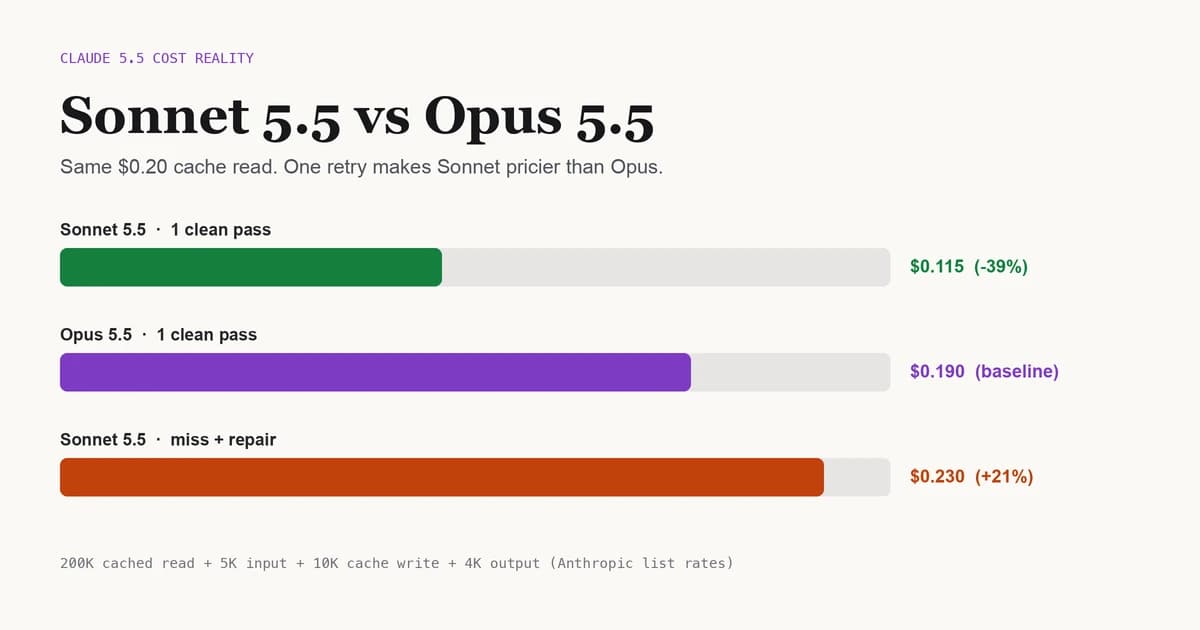
Evaluate both. Many workloads that needed Opus 5 six months ago now pass cleanly on Claude Sonnet 5.5 at half of Opus 5.5's input and output price ($2/$10 list). Read our Claude Sonnet 5.5 vs Opus 5.5 guide and Claude Opus 5.5 prompting guide to split routine work onto Sonnet 5.5 and reserve Opus 5.5 for the hard tasks where its reasoning prevents rework.
When is keeping Claude Opus 5 still the right call?
Stay on Opus 5 temporarily only if your client relies heavily on forced tool_choice or disabled thinking and you cannot ship the client refactor this sprint, or if your canary shows higher latency on a strict sub-second SLA route where low effort on Opus 5.5 is still slower than Opus 5 non-thinking. For almost every cache-heavy agent and coding pipeline, moving to Claude Opus 5.5 pays back quickly once those five compatibility edges are handled.