Claude Fable 5.5 vs Opus 5.5: when would switching actually pay off?
Claude Fable 5.5 is unconfirmed. Use accepted-task cost math, the advisor pattern and Opus 5.5 baselines to decide when a future Fable upgrade would pay off.
Read as MarkdownKeep Claude Opus 5.5 as your default if it already clears your production acceptance checks. Do not freeze roadmaps waiting for a rumored Fable 5.5 release, and do not assume a higher version number automatically beats Opus 5.5 on total cost per finished job.
As of November 23, 2026, Anthropic has not announced Claude Fable 5.5, published a Fable 5.5 model ID, or released a system card or price sheet for it. Anthropic's live model catalog still lists Claude Fable 5.1 (claude-fable-5-1) alongside claude-opus-5-5 and Claude Sonnet 5.5. Every Fable 5.5 claim circulating online still traces back to unverified social posts (see our dated rumor tracker in Claude Fable 5.5 release date).
That does not make the comparison pointless, though. Teams running heavy coding and research agents on Opus 5.5 right now still need a concrete decision bar: if Anthropic ships a pricier Fable tier tomorrow, how much better does it have to be before switching actually saves money or engineering time?
What you can verify today (and what remains unknown)
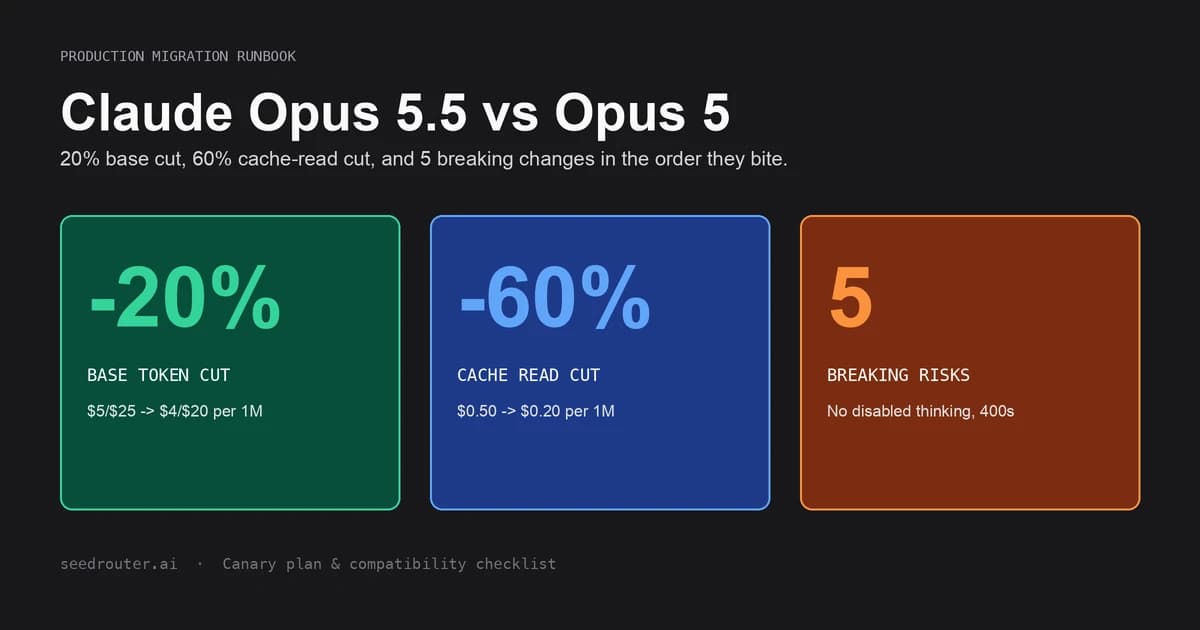
Start by separating documented production facts from speculation. Anthropic's September 22 launch announcement for Opus 5.5 explicitly stated that Opus 5.5 performs at the level of Claude Fable 5.1 on most work while costing 40% less to run than Opus 5, and Anthropic's model overview recommends starting most workloads on Opus 5.5 while reserving Fable 5.1 for unusually demanding reasoning.
| Decision variable | Claude Opus 5.5 (live baseline) | Claude Fable 5.1 (current Fable) | Claude Fable 5.5 (rumored candidate) |
|---|---|---|---|
| Release status | Live (September 22, 2026) | Live (September 1, 2026) | Unconfirmed; no official announcement |
| API model ID | claude-opus-5-5 | claude-fable-5-1 | None published |
| Context / max output | 1M / 128K tokens | 1M / 128K tokens | Unknown |
| Default effort | medium | high | Unknown |
| Standard list input / output | $4.00 / $20.00 per M tokens | Higher Fable tier | Unknown |
| Production role today | Primary default for coding and agent work | Escalation tier for hard reasoning | Do not commit until callable and measured |
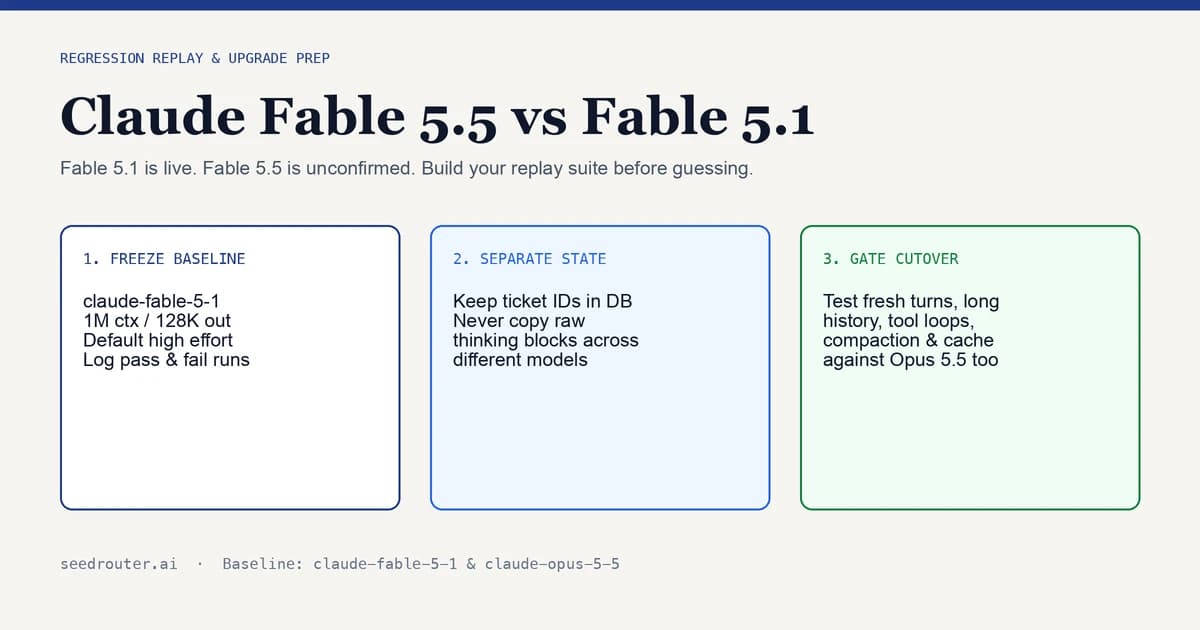
Notice the default effort difference between the two live models: claude-opus-5-5 defaults to medium, whereas claude-fable-5-1 defaults to high. Even when comparing two models that both exist today, leaving effort unset compares unequal thinking budgets. Any future Fable 5.5 evaluation will need explicit effort locking across both routes.
Why Opus 5.5 is already a tough baseline to beat
A lot of teams still mentally compare a future Fable model against older Opus releases. Opus 5.5 moved the baseline significantly upward. In Anthropic's September 22 launch report, Opus 5.5 scored 66.4% on Terminal-Bench 4.0 (at xhigh effort) against 55.8% for Fable 5.1. Independent evaluations show a tighter race on specific coding tasks: Snorkel's September 23 coding study across 24 tasks reported task-level pass@1 of 60.7% for Opus 5.5 versus 61.5% for Fable 5.1, with 136 of 200 trajectories succeeding on Opus 5.5 versus 94 of 191 on Fable 5.1.
The takeaway for engineering leads is simple: Opus 5.5 already clears the majority of hard repository tasks at $4 / $20 per million list tokens and $0.20 per million cached input reads. When your baseline already passes 80% to 85% of a production queue, a more expensive tier has very little room left to win on routine work. It can only pay for itself inside the narrow slice of tasks where Opus 5.5 still fails or forces slow human rework.
Should Opus 5.5 stay my default while Fable 5.5 is unconfirmed?
Yes. Building against claude-opus-5-5 today gives you a stable API contract, predictable billing, and a clean baseline dataset of passed and failed tasks. If Anthropic launches a new Fable model later, you already have the exact failure bucket needed to test whether it earns a slot in your stack.
Build the evaluation bucket where a stronger tier could actually matter
Do not waste test budget comparing a flagship escalation model on tasks Opus 5.5 already passes on the first try. Freeze a focused 20-to-30-task test suite drawn from real tickets where your current Opus 5.5 pipeline struggles:
- Cross-file invariant bugs: defects where a state change in module A quietly violates an assumption in module D, and the failing test only appears in an integration suite the agent cannot see up front.
- Long-context contradiction hunting: 150K+ token specification bundles, legal contracts, or architecture RFCs where two sections conflict and naive summaries smooth over the contradiction.
- Multi-turn tool recovery: workflows where an external API returns a partial failure on turn four and the agent must unwind or resume safely without issuing duplicate writes.
- High-review-cost refactors: PRs where Opus 5.5 produces compiling code that passes unit tests, yet still takes a senior engineer 45 minutes to unwind subtle design mistakes.
Keep API evaluations strictly separate from interactive Claude Code workflow tests. In Claude Code, your prompt compaction cadence, local shell tools, and human mid-session nudges can mask raw model differences. Measure the raw API route with frozen prompts and deterministic checks first; only test interactive terminal sessions once the API numbers clear your cost gate.
The break-even formula: cost per accepted task
Never compare two models on per-million token rates alone. Use one accounting formula across the entire queue:
Cost per Accepted Task = (Token Spend + Tool Fees + Human Repair Cost) / Accepted TasksSuppose your team runs a 100-task hard engineering queue on Opus 5.5 today. At Anthropic's standard list rates (checked on November 23, 2026), assume the queue averages $0.45 in API tokens per task ($45 total) plus 18 minutes of human review and cleanup per task at $60/hour ($1,800 total), and 78 of 100 tasks pass acceptance:
- Opus 5.5 baseline:
($45 + $1,800) / 78 = $23.65 per accepted task. - Hypothetical Fable candidate at 3x Opus token price ($135 total tokens):
- If it only lifts acceptance from 78 to 80 tasks with the same human review time:
($135 + $1,800) / 80 = $24.19(worse than Opus 5.5). - If it lifts acceptance from 78 to 90 tasks and trims average human cleanup from 18 minutes to 12 minutes ($1,200 total):
($135 + $1,200) / 90 = $14.83(37% cheaper per accepted task despite 3x token cost).
- If it only lifts acceptance from 78 to 80 tasks with the same human review time:
Notice what actually decides the math: human review minutes and prevented failures, not whether tokens cost $4 or $12 per million. For automated pipelines with zero human review (pure batch classification or extraction), a 3x token hike almost never pays back. For senior-engineer code review or security triage, saving ten minutes of human cleanup per PR easily pays for a pricier reasoning pass.
Live rates for claude-opus-5-5 and claude-fable-5-1 on SeedRouter are pulled directly from billing:
Claude Opus 5.5
Claude Opus 5.5 is billed per token. Prices below are USD per 1M tokens for each available group, read live from the current billing configuration.
Model ID: claude-opus-5-5.
| Category | claude-0.95 | claude | claude-0.7 |
|---|---|---|---|
| Input | $3.80 | $1.40 | $2.80 |
| Output | $19.00 | $7.00 | $14.00 |
| Cache read | $0.19 | $0.07 | $0.14 |
| Cache write, 5 minutes | $4.75 | $1.75 | $3.50 |
| Cache write, 1 hour | $7.60 | $2.80 | $5.60 |
Total input includes uncached input, cache reads and both cache-write TTLs. When context tiers are shown, the selected tier applies to the whole request. Anthropic reports cache tokens separately from uncached input.
Cost is the sum of each billable token category multiplied by its rate, divided by 1,000,000. Use the rates of the selected group and applicable tier. A request that fails is not charged.
Does using a Fable tier only as an advisor cut cost?
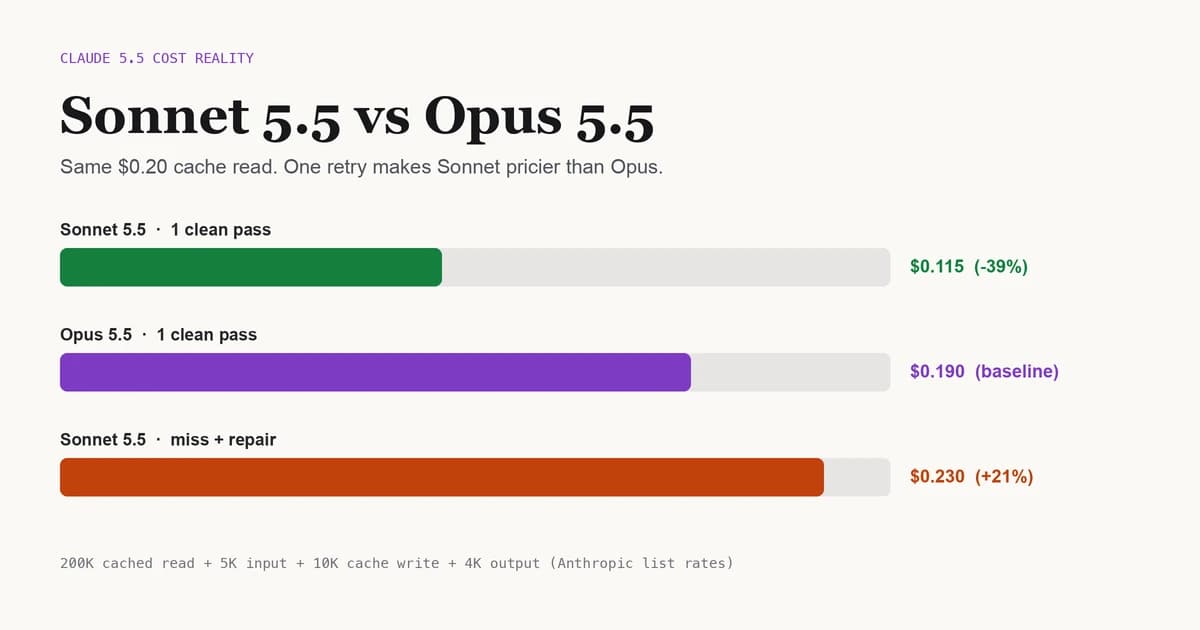
Often yes, and you can test this exact pattern today by pairing Claude Opus 5.5 with Claude Fable 5.1 (or pairing Claude Sonnet 5.5 with Opus 5.5).
In the advisor pattern, your fast, cheaper default model does all of the heavy token lifting: reading 15 files, searching symbols, running tests, and drafting the patch or analysis. You only call the heavier model at two narrow checkpoints: once up front on a 2,000-token problem brief to lock down the architecture plan, or once at the end when the default model's patch fails CI after its first repair attempt.
Because the heavy model never pays to re-read 200K tokens of raw tool logs across fifteen exploratory turns, total token spend stays close to your Opus 5.5 baseline while capturing most of the escalation model's judgment on the hard 15% of tasks.
What happens to thinking blocks when escalating between Claude models?
Do not replay raw thinking blocks from one Claude model into another model's follow-up call. Thinking payloads are bound to the exact model and conversation state that generated them. When escalating a failed turn from Opus 5.5 to Fable 5.1 (or from Sonnet 5.5 to Opus 5.5), pass a clean summary plus the relevant user, assistant, and tool-result history without copying raw thinking blocks across models.
How will I know when Fable 5.5 is actually live and testable?
Wait for four verifiable signals rather than social screenshots: an official announcement on anthropic.com, a new claude-fable-... model ID in Anthropic's models overview, a published system card with list pricing, and a callable ID appearing in GET /v1/models. Until then, compare the two models you can actually ship today in our Claude Fable 5.1 vs Fable 5 vs Opus 5.5 breakdown, and keep your acceptance queue frozen so a real side-by-side run takes one afternoon once a new model lands. Document your current pass rate, average retry count, and human review minutes on Opus 5.5 today so any future Fable release has a concrete baseline to beat rather than a subjective gut feel.