Claude Sonnet 5.5 vs Opus 5.5: which model fits your tasks
Compare Claude Sonnet 5.5 and Opus 5.5 by task, effort controls, cache-read pricing, and cost per accepted task so you know when to start with Sonnet or Opus.
Read as MarkdownStart your evaluation with Claude Sonnet 5.5 for well-scoped daily engineering, bug fixes and structured document workflows; escalate to Claude Opus 5.5 when an open-ended architecture change, ambiguous debugging thread or dense policy review demands sustained judgment across many turns. Both models are live and share the same 1M-token context window and 128K-token output ceiling. On Anthropic's published list rates, Sonnet 5.5 costs half as much per fresh input and output token, yet cached input reads cost the exact same on both models, and Sonnet defaults to a higher reasoning effort than Opus. Swapping model IDs without accounting for cache ratio, effort settings and retry rate rarely cuts a real production bill in half.
Before switching production traffic, check four things: the exact spec and default-effort differences, which task shapes favor Sonnet versus Opus, the API contract rules that skew naive benchmarks, and how shared cache-read pricing changes a real agent invoice.
Confirmed differences between Claude Sonnet 5.5 and Opus 5.5
Specifications compiled from Anthropic's Claude Sonnet 5.5 and Claude Opus 5.5 model overviews, checked on November 23, 2026:
| Decision input | Claude Sonnet 5.5 | Claude Opus 5.5 | Practical impact on an existing app |
|---|---|---|---|
| Official release | September 28, 2026 | September 22, 2026 | Both belong to Anthropic's Claude 5.5 generation |
| API model ID | claude-sonnet-5-5 | claude-opus-5-5 | Pin exact IDs in config; log model ID per request |
| Context / max output | 1M / 128K tokens | 1M / 128K tokens | Context size does not separate the two models |
| Input modalities | Text, images, PDFs | Text, images, PDFs | Both read native PDFs without external OCR |
| Anthropic latency tier | Fast | Moderate | Sonnet wins interactive time-to-first-token |
Default output_config.effort | high | medium | Leaving effort unset compares unequal reasoning budgets |
| Skip up-front thinking | Supported via between_tools (high or below) | Not supported (always thinks up front) | Sonnet can begin tool calls faster on simple steps |
| Standard list input / output | $2.00 / $10.00 per M tokens | $4.00 / $20.00 per M tokens | Half price on fresh input and generated output |
| Standard list cache write (5m) | $2.50 per M tokens | $5.00 per M tokens | Half price when seeding a new prompt cache |
| Standard list cache read | $0.20 per M tokens | $0.20 per M tokens | Identical rate (cache-heavy agents save under 50%) |
Unlike some competing model families, Anthropic's standard rates do not jump above a mid-window prompt threshold. The live rates your SeedRouter account pays are read directly from billing:
Claude Sonnet 5.5
Claude Sonnet 5.5 is billed per token. Prices below are USD per 1M tokens for each available group, read live from the current billing configuration.
Model ID: claude-sonnet-5-5.
| Category | claude-0.7 | claude-0.95 | claude |
|---|---|---|---|
| Input | $1.40 | $1.90 | $0.70 |
| Output | $7.00 | $9.50 | $3.50 |
| Cache read | $0.07 | $0.095 | $0.035 |
| Cache write, 5 minutes | $1.75 | $2.375 | $0.875 |
| Cache write, 1 hour | $2.80 | $3.80 | $1.40 |
Total input includes uncached input, cache reads and both cache-write TTLs. When context tiers are shown, the selected tier applies to the whole request. Anthropic reports cache tokens separately from uncached input.
Cost is the sum of each billable token category multiplied by its rate, divided by 1,000,000. Use the rates of the selected group and applicable tier. A request that fails is not charged.
Claude Opus 5.5
Claude Opus 5.5 is billed per token. Prices below are USD per 1M tokens for each available group, read live from the current billing configuration.
Model ID: claude-opus-5-5.
| Category | claude | claude-0.7 | claude-0.95 |
|---|---|---|---|
| Input | $1.40 | $2.80 | $3.80 |
| Output | $7.00 | $14.00 | $19.00 |
| Cache read | $0.07 | $0.14 | $0.19 |
| Cache write, 5 minutes | $1.75 | $3.50 | $4.75 |
| Cache write, 1 hour | $2.80 | $5.60 | $7.60 |
Total input includes uncached input, cache reads and both cache-write TTLs. When context tiers are shown, the selected tier applies to the whole request. Anthropic reports cache tokens separately from uncached input.
Cost is the sum of each billable token category multiplied by its rate, divided by 1,000,000. Use the rates of the selected group and applicable tier. A request that fails is not charged.
Notice how deceptive a quick glance at headline pricing can be. If you compare Sonnet 5.5 at its default (high) against Opus 5.5 at its default (medium), Sonnet can emit more reasoning tokens per turn than expected while Opus stays concise. Always pin output_config.effort explicitly on both sides before comparing latency or spend.
Choose your first candidate by task shape, then measure
Anthropic positions Sonnet 5.5 as its complement to Opus 5.5 for well-defined everyday work, while noting that Opus remains stronger on complex, open-ended tasks. Treat that positioning as an initial routing hypothesis, not as a substitute for testing your own acceptance criteria.
In a coding workflow, draw a hard line between an isolated bug with a clean reproduction test and an ambiguous refactor spanning several services. Sonnet 5.5 is the obvious first candidate for the isolated bug: the target behavior is observable, the feedback loop is tight, and lower latency speeds up iteration. Opus 5.5 earns its place on cross-system design work, tricky concurrency issues or legacy migrations where a subtle wrong assumption triggers three rounds of human rework.
The same distinction applies to document and knowledge pipelines. If your current model occasionally drops a required citation, misreads a nested table or merges two conflicting clauses into one smoothed-over paragraph, build your test set directly from those failure cases instead of judging which model writes smoother prose.
| Workload situation | First candidate to test | Evidence required to promote or escalate |
|---|---|---|
| Scoped bug fix or well-specified feature | Claude Sonnet 5.5 | Patches pass hidden regression tests on first pass within latency budget |
| Ambiguous architecture or cross-service change | Claude Opus 5.5 | Requirements resolved with fewer repair loops and zero critical regressions |
| Structured extraction from PDFs and forms | Claude Sonnet 5.5 | Schema validation and source-fact accuracy hold across messy scans |
| Long policy or contract review with conflicting rules | Claude Opus 5.5 | Contradictions surfaced with traceable citations and less manual editing |
| High-volume classification or routing | Claude Sonnet 5.5 (low or between_tools) | Latency and accuracy stay inside SLA; if still oversized, test Claude Haiku 5.5 |
| Multi-agent workflows repeating or undoing edits | Measure the full handoff chain first | Fewer failed handoffs and lower cost per completed workflow |
Include ordinary noisy inputs and last month's production failures in your test queue. An evaluation built only from clean toy prompts hides every situation where Opus 5.5 justifies its higher rate.
Effort settings and API compatibility rules that change the outcome
Treat a candidate as a complete bundle: model ID + effort level + thinking mode + prompt + tool definitions. Comparing Sonnet at low against Opus at high and crediting the entire cost drop to the model produces misleading benchmarks. Run a controlled effort sweep (low, medium, high, and xhigh where needed) while holding the prompt, tools and acceptance checks fixed.
Before reusing an older Claude client, check four Claude 5.5 contract details that affect both models:
- Forced
tool_choiceis rejected. Neither Sonnet 5.5 nor Opus 5.5 accepts forcing a named tool or forcing "any tool." Both acceptautoandnone. Steer tool invocation through explicit system instructions and unambiguous tool descriptions instead of relying ontool_choice: { type: "tool", name: "..." }. - Thinking history is model-bound. Do not copy raw thinking blocks from a Sonnet 5.5 turn and replay them into an Opus 5.5 escalation call (or vice versa). When handing a conversation from Sonnet to Opus mid-session, strip prior thinking payloads and pass the clean user, assistant and tool-result history.
between_toolsis Sonnet-only and effort-bounded. On Sonnet 5.5,between_toolslets you skip up-front thinking atlow,mediumorhigheffort. It cannot be combined withxhighormax, and progress notes between tool calls can still arrive inside thinking blocks. Verify your response renderer handles non-text blocks gracefully rather than dropping them.- Sampling fields do not vary reasoning. Do not depend on
temperatureortop_pto diversify outputs while thinking is active.
For full launch compatibility notes and observed edge cases on Sonnet 5.5, see our Claude Sonnet 5.5 release notes and the Claude Opus 5.5 prompting guide.
Compare cost per accepted task, not list token rates
In multi-turn coding and document agents, cached prompt prefixes often account for 80–95% of total input tokens. Because Anthropic prices cache reads at $0.20 per million tokens on both Sonnet 5.5 and Opus 5.5, the real bill behaves very differently from a simple 2x ratio.
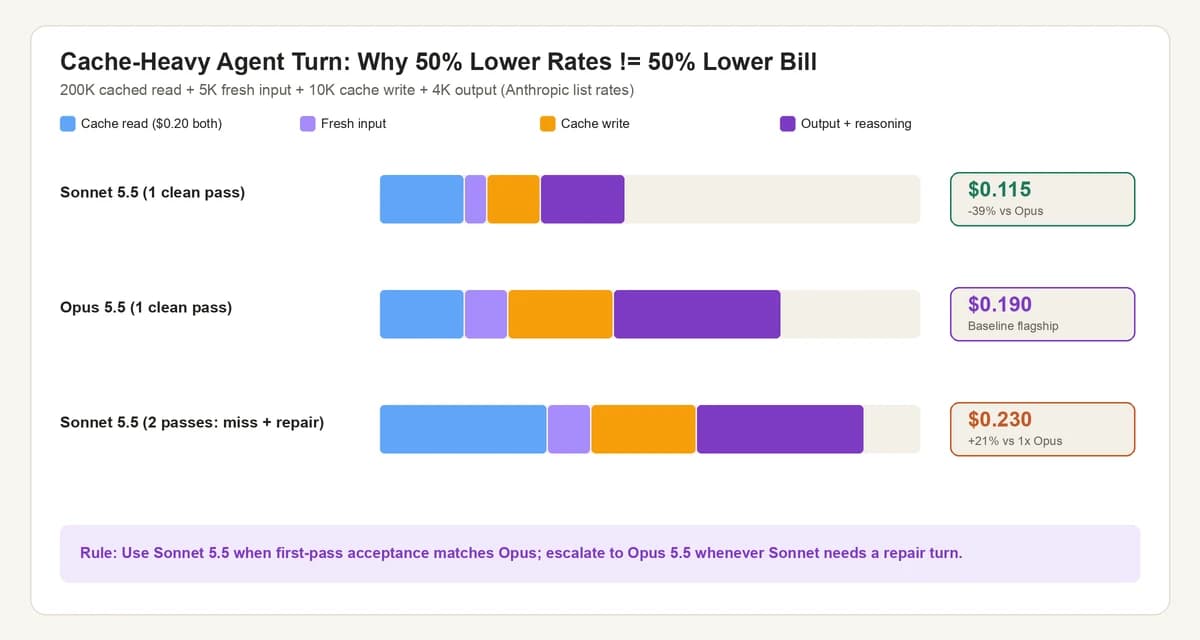
Walk through one realistic cache-heavy agent turn: 200,000 cached input tokens, 5,000 fresh input tokens, 10,000 cache-write tokens, and 4,000 output tokens (including reasoning), priced at Anthropic's standard list rates:
| Scenario | Cache read ($0.20 both) | Fresh input | Cache write (5m) | Output + reasoning | Total cost | Relative to 1x Opus |
|---|---|---|---|---|---|---|
| Sonnet 5.5 (1 clean pass) | $0.040 | $0.010 | $0.025 | $0.040 | $0.115 | -39.5% |
| Opus 5.5 (1 clean pass) | $0.040 | $0.020 | $0.050 | $0.080 | $0.190 | Baseline |
| Sonnet 5.5 (2 passes: miss + repair) | $0.080 | $0.020 | $0.050 | $0.080 | $0.230 | +21.1% more expensive |
Two practical lessons fall straight out of that table:
- Even on a clean first-pass win, Sonnet 5.5 saves 39.5%, not 50%, because cache reads cost $0.04 on both sides. If your agent hits 500K cached tokens per turn, the shared cache-read line shrinks the gap further.
- One extra repair turn flips the winner completely. Paying $0.230 for two Sonnet passes (plus double the wall-clock wait and extra human review time) costs more than paying $0.190 for one clean Opus 5.5 run.
That is why mature teams track cost per accepted task across a 30–50 task queue:
Accepted-task cost = (all token charges across initial runs + retries + tool fees + human review cost) ÷ tasks that passed acceptance
If Sonnet 5.5 passes 92% of your scoped bug queue on the first try, it is an easy financial win. If it passes 65% of your cross-service architecture queue while Opus 5.5 passes 90%, Opus is cheaper per finished feature.
Test the workflow before splitting traffic across both models
Resist the temptation to build a complicated multi-model router on day one. Follow a three-step rollout instead:
- Establish a single-model baseline first. Run 20–30 frozen tasks through Claude Sonnet 5.5 with explicit
output_config.effort(mediumfor routine tasks,highfor coding) and record pass rate, retries, elapsed time and token usage. - Replay only the failures and high-review items on Claude Opus 5.5. If Opus resolves the exact failure bucket cleanly in one pass, you now have an objective rule for escalation instead of a hunch.
- Wire a clean two-tier boundary. Keep Sonnet 5.5 as the default for daily work, and escalate to
claude-opus-5-5automatically only when a bounded trigger fires (for example: unit tests still fail after one Sonnet repair turn, a diff touches more than five modules, or a document task flags conflicting clauses).
Because claude-sonnet-5-5 and claude-opus-5-5 share one API key, one Messages endpoint and one pay-as-you-go balance on SeedRouter, you can run paired evaluations and switch tiers by changing a single model string, with zero separate subscriptions and no charge for failed requests. If you are also weighing GPT-6.1 Sol against Claude, see our GPT-6.1 Sol vs Claude Opus 5.5 and Sonnet 5.5 comparison, or check Claude Haiku 5.5 for ultra-fast lightweight routing.
Edge cases teams ask about before switching
Is Claude Sonnet 5.5 better than Claude Opus 5.5?
Neither wins every task. Sonnet 5.5 is faster and cheaper on well-scoped edits, extraction and daily tool workflows, and it lets you skip up-front thinking with between_tools. Opus 5.5 is stronger on open-ended reasoning, complex multi-file architecture and ambiguous debugging where first-pass accuracy prevents expensive rework.
Is Claude Sonnet 5.5 half the cost of Claude Opus 5.5?
Only on fresh input ($2 vs $4), cache writes ($2.50 vs $5) and output ($10 vs $20) at Anthropic's standard list rates. Cached input reads are $0.20 per million tokens on both models, so cache-heavy agents typically save 30%–40% rather than 50%, and only if retry rates stay equal.
Should I leave output_config.effort at the default during a benchmark?
No. Sonnet 5.5 defaults to high while Opus 5.5 defaults to medium. Set output_config.effort explicitly on both models so you know whether a latency or quality shift came from the model or the reasoning budget.
Can I pass Sonnet 5.5 thinking blocks into an Opus 5.5 follow-up call?
No. Thinking blocks are bound to the model and conversation state that produced them. Strip prior thinking blocks and send clean user/assistant/tool history when escalating a session from Sonnet 5.5 to Opus 5.5.
When should I consider Claude Haiku 5.5 instead of Sonnet 5.5?
When your task is high-volume classification, routing, short tagging or simple formatting where Sonnet 5.5's reasoning overhead is unnecessary. See our Claude Haiku 5.5 vs Sonnet 5.5 comparison for where the lighter tier fits.