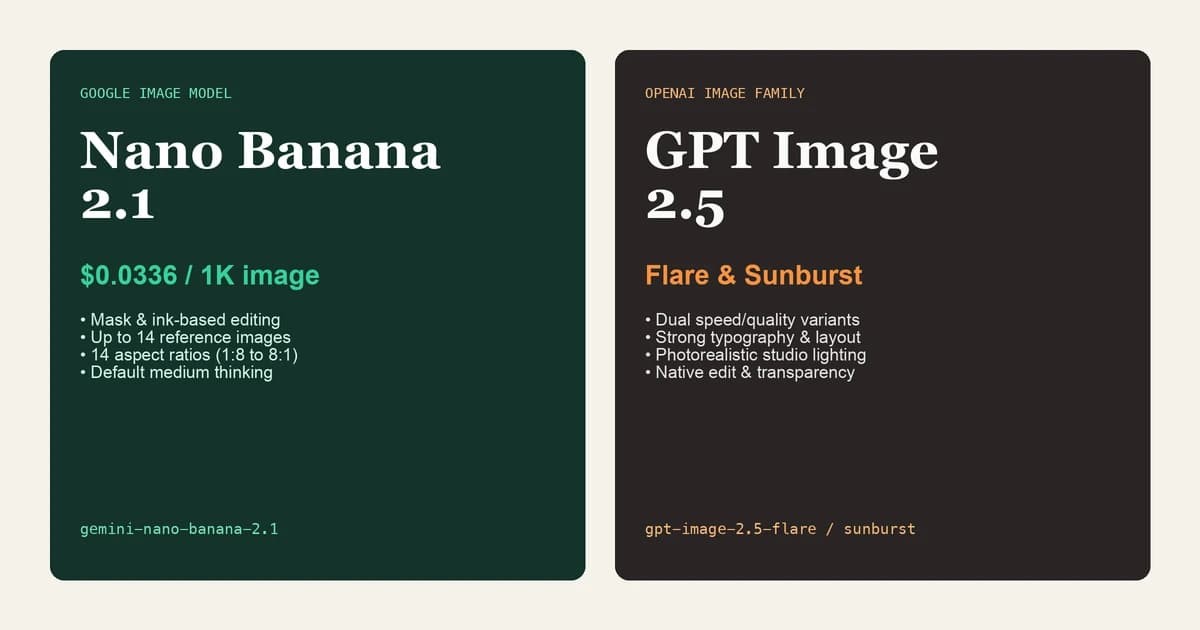
What is Nano Banana 2.1? Mask-based editing, specs, Elo scores and price
What is Nano Banana 2.1? Explore Google’s October 2026 image model: mask-based editing, 14 reference images, 14 aspect ratios, $0.0336 1K pricing and API ID.
Read as MarkdownNano Banana 2.1 (gemini-nano-banana-2.1) is Google's updated Flash-class image generation and editing model, released on October 6, 2026 as the direct replacement for Nano Banana 2 (gemini-3.1-flash-image, which Google scheduled for API shutdown on October 29, 2026). Built on Gemini 3.6 Flash, it pairs faster, lower-cost 1K/2K image rendering ($0.0336 per 1K image at Google's Standard list rate, half the image-output cost of Nano Banana 2) with major upgrades to mask- and ink-based editing, multi-character consistency, infographic typography, and wide/tall aspect ratios.
If you read early October coverage claiming Nano Banana 2.1 had no published API ID, price, or benchmarks, that information is already outdated. Google has since published the stable gemini-nano-banana-2.1 model ID, full token pricing, and model-card Elo benchmarks, and the model is live on SeedRouter today.
What real Nano Banana 2.1 output looks like
Here is an actual 1K 16:9 (1376 × 768) output generated through Nano Banana 2.1 with default medium thinking on a photorealistic scene prompt:

Nano Banana 2.1, 1K (1376 × 768), default medium thinking. Clean fur detail, dawn lighting, and wide framing with no seam artifacts.
For side-by-side output comparisons against its predecessor and OpenAI's image lineup, see Nano Banana 2.1 vs Nano Banana 2 and Nano Banana 2.1 vs GPT Image 2.5.
Core specifications and what changed from Nano Banana 2
Verified against Google's Gemini API changelog, model card, and image generation documentation, checked on November 23, 2026:
| Spec | Nano Banana 2.1 | Change vs Nano Banana 2 |
|---|---|---|
| Official API model ID | gemini-nano-banana-2.1 | Replaces gemini-3.1-flash-image |
| Release date | October 6, 2026 | Stable GA; Nano Banana 2 deprecated Oct 29 |
| Output resolutions | 1K, 2K, 4K | 512px dropped; smallest size is now 1K |
| Aspect ratios | 14 ratios from 1:8 to 8:1 | Fixed tiling/seam artifacts on 1:4, 4:1, 1:8, 8:1 at 2K/4K |
| Thinking levels | minimal, medium (default), high | New medium tier added and made the default |
| Reference image limit | Up to 14 images (10 objects + 4 characters) | Stronger multi-turn character fidelity |
| Multimodal inputs | Text, image, video frames, PDF | Same broad input support |
| Google list image price (1K / 2K / 4K) | $0.0336 / $0.0504 / $0.113 | Half price at 1K and 2K; ~25% cheaper at 4K |
Five upgrades define why Google shipped 2.1 rather than keeping Nano Banana 2 around:
- Mask- and ink-based editing: lets applications target localized regions (changing a garment, swapping a label, removing an object) while keeping surrounding lighting and geometry untouched.
- Multi-character and multi-reference consistency: holding up to 4 recurring characters and 10 reference objects across sequential edits without faces or outfits drifting.
- Cleaner wide and tall banners: fixing the repeated tiling seams that used to ruin
1:4,4:1,1:8, and8:1strips at 2K and 4K. - Sharper typography and infographics: pairing image synthesis with
mediumdefault thinking so labels, charts, and layout grids hold factual accuracy far better. - Half-price image tokens at 1K and 2K: cutting the image output rate from $60/M tokens to $30/M tokens.
Google's model card benchmarks (and honest limitations)
Google DeepMind evaluated Nano Banana 2.1 using blind side-by-side human preference Elo ratings against Nano Banana 2 and Nano Banana Pro (checked on November 23, 2026):
| Evaluation category | Nano Banana 2.1 (thinking) | Nano Banana 2.1 (no thinking) | Nano Banana 2 (thinking) | Nano Banana Pro |
|---|---|---|---|---|
| Text to image, overall preference | 1050 | 1015 | 990 | 935 |
| Infographic design | 1048 | 1001 | 961 | 912 |
| General editing | 1026 | 980 | 938 | 939 |
| Multi-character consistency | 1106 | 1068 | 978 | 1011 |
| Mask and ink-based editing | 1049 | 1042 | 965 | 927 |
| Multi-reference editing | 1066 | 1041 | 988 | 989 |
Google's model card also reports an infographic factuality score of 0.521 with thinking enabled, up from 0.179 on Nano Banana 2.
At the same time, early community tests show Nano Banana 2.1 is not magic. Independent testers noted strong performance on editorial layouts, handwriting, and product mockups, while still spotting occasional failures on strict spatial puzzles (like solved Rubik's Cube face geometry) and tricky finger-counting edge cases. Always run your own 10-prompt acceptance check rather than trusting a single Elo number.
Token pricing: cheaper images, pricier surrounding tokens
Understanding Nano Banana 2.1's bill requires looking at both sides of Google's Standard rate card (checked on November 23, 2026):
| Token category (Google Standard list) | Nano Banana 2.1 | Nano Banana 2 |
|---|---|---|
| Input (text & reference images) | $1.50 / 1M tokens | $0.50 / 1M tokens |
| Text & thinking output | $7.50 / 1M tokens | $3.00 / 1M tokens |
| Image output | $30.00 / 1M tokens | $60.00 / 1M tokens |
Each generated image consumes 1,120 image tokens at 1K ($0.0336), 1,680 tokens at 2K ($0.0504), and 3,780 tokens at 4K ($0.113). Notice the subtle tradeoff: image pixels themselves dropped by 50% at 1K and 2K, while input and thinking tokens rose from $0.50/$3.00 to $1.50/$7.50. For normal prompts with 1 to 3 reference images, total cost per image still drops sharply. If your pipeline attaches 14 huge reference images and runs high thinking on every draft, input and thinking tokens become a visible share of the invoice.
Live billing rates on SeedRouter are pulled directly from billing:
Nano Banana 2.1 (Gemini Nano Banana 2.1) is sold on 2 channels. Both IDs accept the same request body; pick the ID whose billing suits the request.
| Channel | Model IDs | Billed by | Current rate (USD) |
|---|---|---|---|
| Standard | gemini-nano-banana-2.1 | Flat price per delivered image, at any size | $0.021 per delivered image |
| Official | gemini-nano-banana-2.1-official | Tokens each render reports (input + image output + text and thinking output) | $0.975 per 1M input tokens; $19.5 per 1M image output tokens; $4.875 per 1M text and thinking output tokens |
Token rates are the published first-tier rates; usage in a different tier may be charged differently.
Cost of one image by image size
Image tokens per size are the counts Google publishes for Gemini Nano Banana 2.1. Token-billed figures add a measured sample of 1177 text and thinking output tokens and 22 prompt tokens; actual usage varies with the prompt, references and thinking, so they are estimates, not fixed prices. Flat-priced channels charge the same at every size.
| Image size | Image output tokens | Standard USD | Official USD |
|---|---|---|---|
| 1K | 1120 | $0.021 | $0.02759933 |
| 2K | 1680 | $0.021 | $0.03851933 |
| 4K | 3780 | $0.021 | $0.07946932 |
Formula (Official): (input tokens × 0.975 + image output tokens × 19.5 + text and thinking output tokens × 4.875) / 1,000,000 USD. One request returns one image. Final charges are available in account usage history. Failed requests are not charged.
For worked per-image calculations across 1K, 2K, and 4K batches, read our Nano Banana 2.1 API pricing guide.
Best production use cases and when to pick another model
Nano Banana 2.1 is an easy default for four workflows:
- Ecommerce and brand catalogs needing consistent product placement across up to 14 reference assets.
- Marketing infographics, diagrams, and social strips where readable text and clean
4:1/1:4banners matter. - Localized mask/ink editing tools where users brush over one region and expect the rest of the frame to stay locked.
- High-volume 1K/2K pipelines where cutting image-token cost in half directly improves margins.
Consider pairing or comparing it with GPT Image 2.5 (or GPT Image 2) when you need native transparent PNG cutouts (background: "transparent") or want to test studio product lighting side by side.
Migration checklist from Nano Banana 2 to 2.1
Because Google deprecated gemini-3.1-flash-image on October 29, 2026, most teams migrating existing image pipelines only need four targeted code updates rather than a full rewrite:
- Swap the model ID from
gemini-3.1-flash-imagetogemini-nano-banana-2.1. - Replace
512pxrequests with1K. Any legacy thumbnail or preview job still passing512will fail validation on 2.1. Moving those calls to1Kdoubles both pixel dimensions while keeping image-output cost comparable thanks to the 50% token rate drop. - Audit
thinking_levelper route. Nano Banana 2.1 defaults tomediumthinking instead of minimal/off. Leavemediumon for typography, charts, product labels, and multi-reference edits, and explicitly passminimalon high-volume decorative backgrounds where extra thinking tokens add latency and text-output spend without visible quality gain. - Trim unused reference attachments. Because input tokens rose from $0.50 to $1.50 per million on Google's list card, avoid attaching ten high-resolution reference photos to prompts that only need two product angles. Keep reference sets tight and reuse cropped subject sheets when locking character identity across multi-turn edits.
Did Nano Banana 2.1 really drop 512px output?
Yes. Google's image generation guide explicitly states that 512px is not supported on gemini-nano-banana-2.1. Update any legacy Nano Banana 2 draft script that passed 512 to request 1K instead; because 1K image tokens are half the price of Nano Banana 2, migrating drafts to 1K keeps unit cost low while giving you four times the pixels.
Should I keep medium thinking on or switch to minimal?
Keep medium (the default) for text rendering, infographics, multi-reference compositing, and complex edits where layout accuracy matters. Switch to minimal when generating fast background textures, abstract moods, or high-volume drafts where thinking tokens add latency without improving usability.
How can I try Nano Banana 2.1 without setting up a Google Cloud billing project?
Open the Nano Banana 2.1 model page on SeedRouter to test prompts directly in the browser Playground, or call gemini-nano-banana-2.1 over API using one pay-as-you-go SeedRouter key (credits never expire, and failed requests are not charged). You can upload reference images, toggle 1K/2K/4K resolutions, compare minimal versus medium thinking on your own brand prompts, and verify exact aspect-ratio framing before writing a single line of integration code. Once your prompt template and reference set look consistent at full display size, copy the exact parameters straight into your production image pipeline.