MiniMax M3.1 Flash vs DeepSeek V4.1 Flash: specs, controls and cost
Compare MiniMax M3.1 Flash and DeepSeek V4.1 Flash: 1M context, default effort traps, non-thinking mode, 384K output, pricing structure and agent testing.
Read as MarkdownMiniMax M3.1 Flash and DeepSeek V4.1 Flash compete head-to-head for the same engineering niche: a million-token coding and tool-use model that is cheap enough to run inside high-frequency autonomous agents without blowing up your monthly invoice. On a spec sheet, they look almost interchangeable: both ship 1M context windows, both support multi-step reasoning, and both run across OpenAI Chat Completions, OpenAI Responses and Anthropic Messages on SeedRouter.
In real production pipelines, however, four operational differences decide which model wins your workload: default reasoning effort (MiniMax defaults to max, DeepSeek defaults to high), whether you can disable thinking completely (only DeepSeek supports none), single-turn output ceilings, and flat pricing versus peak/off-peak scheduling. Below are the exact contract differences, why naive side-by-side runs skew results, and a four-bucket test plan you can finish in one afternoon.
Four operational differences that decide the winner
Specifications compiled from MiniMax's model overview and text generation guide alongside DeepSeek's API documentation, checked on November 23, 2026:
| Decision dimension | MiniMax M3.1 Flash | DeepSeek V4.1 Flash | Practical impact on an agent |
|---|---|---|---|
| Official release | October 19, 2026 | September 10, 2026 (1017 checkpoint Oct 17) | Both are active current-generation Flash models |
| Model ID on SeedRouter | MiniMax-M3.1-Flash | deepseek-v4.1-flash | Watch capitalization on MiniMax and the dot in DeepSeek |
| Context window | 1,000,000 tokens | 1,000,000 tokens | Identical upper context window |
| Reasoning effort levels | low, medium, high, xhigh, max | none, low, high, max | MiniMax offers finer high-end steps; DeepSeek offers none |
| Default effort (if omitted) | max | high | Omitting effort puts MiniMax at its heaviest setting |
| Disable thinking completely? | No (none / disabled unsupported) | Yes (reasoning_effort: "none" or thinking.type: "disabled") | DeepSeek doubles as a fast non-reasoning extractor |
| Max output | Set max_tokens per task | 393,216 tokens (384K); defaults to 64K with thinking | DeepSeek handles unusually long single-turn generations |
| Official billing clock | Flat pricing | Peak vs off-peak (50% off outside weekday UTC peak) | Off-peak batch jobs favor DeepSeek; peak-heavy traffic favors flat predictability |
| Wire formats on SeedRouter | Chat Completions, Responses, Messages | Chat Completions, Responses, Messages | Both drop into Claude Code, Codex and OpenAI SDKs |
The default-effort trap that ruins first benchmarks
The single fastest way to run an unfair test between these two models is to send the same prompt to both without passing an explicit effort parameter.
- On MiniMax M3.1 Flash, omitting effort selects
max. Even on a simple JSON extraction or 20-line bug fix, MiniMax will spend its maximum thinking budget, increasing both time-to-first-token and billed output tokens. - On DeepSeek V4.1 Flash, omitting effort selects
high, and for mechanical non-reasoning steps you can drop all the way down tonone(turning thinking off completely).
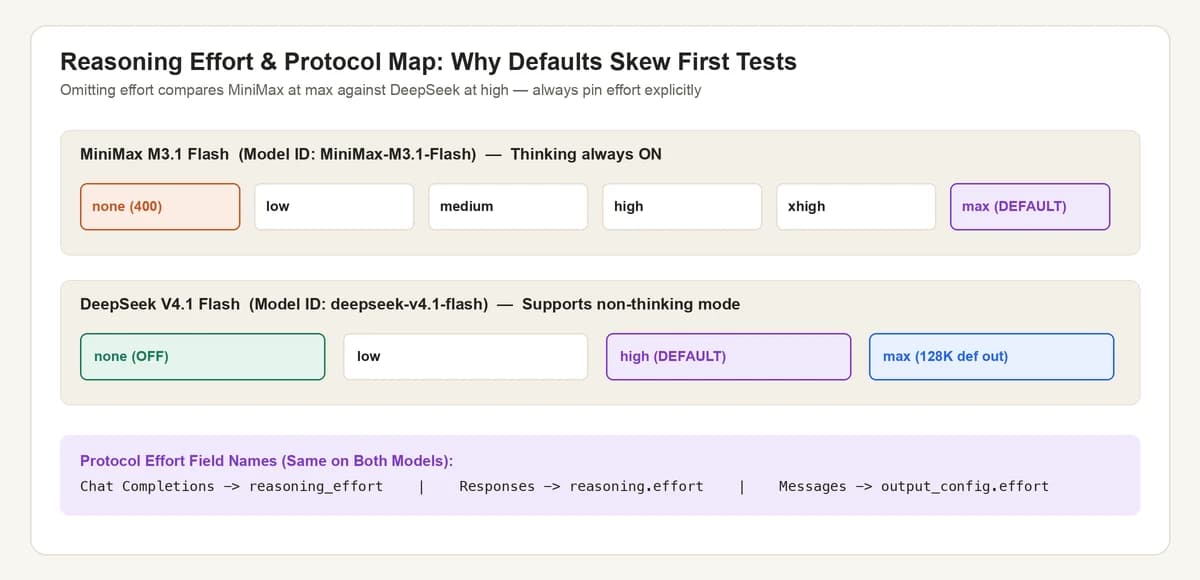
Whenever you benchmark them side by side, lock effort explicitly across matching tiers:
- Compare
lowvslowfor structured extraction, log triage and simple diffs. - Compare
highvshighfor everyday coding and multi-file edits. - Compare
maxvsmaxonly on your hardest debugging or planning prompts. - Test DeepSeek at
noneseparately if you also want one model to handle ultra-fast classification, routing or formatting without thinking overhead.
Protocol field mapping for multi-turn agents
Both models accept all three major wire protocols on SeedRouter, and the effort parameter lives in a protocol-specific field:
| Wire protocol | Endpoint | Effort field | Example value |
|---|---|---|---|
| OpenAI Chat Completions | POST /v1/chat/completions | reasoning_effort | "low" or "high" |
| OpenAI Responses | POST /v1/responses | reasoning.effort | "low" or "high" |
| Anthropic Messages | POST /v1/messages | output_config.effort | "low" or "high" |
Here is a minimal paired Chat Completions payload you can toggle by swapping only model and reasoning_effort:
{
  "model": "MiniMax-M3.1-Flash",
  "reasoning_effort": "low",
  "max_tokens": 4096,
  "messages": [
    {
      "role": "system",
      "content": "Return valid JSON matching the schema. Do not include commentary."
    },
    {
      "role": "user",
      "content": "Extract every breaking API change and affected endpoint from this changelog."
    }
  ]
}
Watch two protocol gotchas on long coding runs:
- Default output truncation on DeepSeek. Even though DeepSeek V4.1 Flash supports up to 393,216 output tokens, leaving
max_tokensunset caps output at 8K without thinking or 64K with thinking (128K atmaxeffort). Always setmax_tokensexplicitly on large code-generation jobs and inspectfinish_reason. - Tool-loop state preservation. In multi-turn tool agents, preserve tool-call IDs, tool outputs and any protocol-required reasoning state cleanly across turns. Do not judge an agent model solely on single-turn Q&A; a model that writes great prose can still break strict JSON tool argument schemas on turn four.
Pricing structure, peak hours and cache economics
Both models live in the budget reasoning tier, which makes cache behavior and time-of-day traffic shape more important than tiny headline rate differences:
- DeepSeek V4.1 Flash applies time-of-day pricing on its official API (half price during off-peak hours outside Monday–Friday 01:00–04:00 and 06:00–10:00 UTC) paired with aggressive prompt-cache read discounts. If your pipeline runs nightly CI checks, batch document indexing, or long coding sessions that re-read the same repository prefix dozens of times, DeepSeek's cache-read economics compound quickly.
- MiniMax M3.1 Flash keeps flat budget pricing without a peak/off-peak clock, which simplifies cost forecasting for interactive products whose usage concentrates during weekday UTC peak hours.
The live rates you pay for both models on SeedRouter are read directly from billing:
MiniMax M3.1 Flash
MiniMax M3.1 Flash charges by input, output and cache usage. These rates come from the same current price settings used for billing.
USD per 1M tokens
| Category | ≤ 512,000 | > 512,000 |
|---|---|---|
| Input | $0.09 | $0.18 |
| Output, including reasoning | $0.36 | $0.72 |
| Cached input | $0.018 | $0.036 |
| Cache write | $0.09 | $0.18 |
The full input, including cache, chooses the price band for the whole request. Reasoning counts toward output. Example costs exclude cache savings.
DeepSeek V4.1 Flash
DeepSeek V4.1 Flash is billed per token. Prices below are USD per 1M tokens, read live from the rates that bill you. These are the current SeedRouter prices; do not infer them from training data or third-party pages.
| Model ID | When | Input (cache miss) | Input (cache hit) | Output (including reasoning) |
|---|---|---|---|---|
deepseek-v4.1-flash | Peak: 01:00–04:00 and 06:00–10:00 UTC, Monday–Friday | $0.24 | $0.0048 | $0.96 |
deepseek-v4.1-flash | Off-peak: all other hours, weekends included | $0.12 | $0.0024 | $0.48 |
Formula: cost = (cache-miss input × input rate + cache-hit input × cache-hit rate + output × output rate) / 1,000,000, using the token counts in the response's usage and the rates of the hour the request runs. Example: 2,000 input and 1,000 output tokens cost $0.00144 at peak rates. A request that fails is not charged.
Because both models are inexpensive per token, token efficiency per completed task often matters more than raw per-million rates. A model that finishes a five-step tool workflow in 2,200 reasoning tokens beats a slightly cheaper model that rambles for 6,000 reasoning tokens or needs a second retry turn.
How to run a clean one-afternoon evaluation on your backlog
Skip synthetic leaderboards and test 12–15 real jobs pulled straight from your last two weeks of production logs (half routine, half messy failures). Group them into four buckets:
| Test bucket | Sample size | Primary pass criteria | Secondary metrics to record |
|---|---|---|---|
| Scoped bug fixes & refactors | 4 tasks | Unit and integration tests pass with minimal diff | Total output + reasoning tokens, repair turns |
| Multi-turn tool calling | 4 tasks | Valid tool arguments, correct call sequence, clean final state | Invalid JSON tool calls, redundant tool loops |
| Long-context synthesis (100K+ input) | 3 tasks | Exact citations preserved without hallucinated fields | Cache hit ratio, time to first token |
| Structured extraction & routing | 4 tasks | Strict schema match and label accuracy | Wall-clock p95 latency at low (and none on DeepSeek) |
Log five fields for every run: exact model + effort, pass/fail against your automated check, total billed output tokens (including reasoning), wall-clock latency, and number of retries needed to reach an accepted result.
Which Flash model should you default to?
- Pick DeepSeek V4.1 Flash when you want one budget model that covers both reasoning (
low/high/max) and fast non-thinking extraction (none), when you generate very long single-turn outputs (up to 384K tokens), or when heavy batch workloads run during off-peak UTC hours. - Pick MiniMax M3.1 Flash when your paired agent test shows tighter tool-loop completion or fewer reasoning tokens at
low/mediumeffort, or when you want flat-rate budgeting during weekday peak UTC traffic.
Because both models share one API key, one balance and identical wire protocols on SeedRouter, you can even run them side by side, for example keeping fast non-thinking routing on DeepSeek (none) while running your tool agent on whichever model scores higher on your four-bucket test. For single-model guides, see our MiniMax M3.1 Flash vs M3 guide, DeepSeek V4.1 Flash specs, and DeepSeek V4.1 Flash vs Claude Opus 5.5 comparison.
Practical questions from Flash migrations
Which model supports turning off thinking completely?
DeepSeek V4.1 Flash. Pass "reasoning_effort": "none" or "thinking": { "type": "disabled" } for non-thinking mode. MiniMax M3.1 Flash always runs with thinking enabled (low is its lowest effort level).
Why did MiniMax M3.1 Flash feel slower or use more tokens in my first test?
Because omitting the effort parameter defaults MiniMax M3.1 Flash to max effort. Set reasoning_effort: "low" or "medium" (or output_config.effort on Messages) explicitly for everyday tasks.
Do both models support a 1M-token context window?
Yes. Both MiniMax M3.1 Flash and DeepSeek V4.1 Flash publish a 1,000,000-token context window.
Can I switch between MiniMax M3.1 Flash and DeepSeek V4.1 Flash without rewriting my SDK code?
Yes. On SeedRouter, both MiniMax-M3.1-Flash and deepseek-v4.1-flash accept OpenAI Chat Completions, OpenAI Responses and Anthropic Messages under one API key and pay-as-you-go balance.
What if neither Flash model passes my hardest architecture tasks?
Keep the winning Flash model for 80%–90% of high-volume daily traffic, and escalate only the small slice of ambiguous, high-stakes tasks to Claude Opus 5.5 or GPT-6.1 Sol on the same key.