
GPT-6.1 Sol vs GPT-6 Sol: same base rates, lower cache cost, new migration rules
Compare GPT-6.1 Sol and GPT-6 Sol: unchanged input and output rates, half-price cache reads, Responses-only tool calling, 6-job paired eval and 100-task math.
Read as MarkdownEvaluate GPT-6.1 Sol if you want stronger multi-step coding and agent performance at GPT-6 Sol's exact standard input and output list rates, especially when your workload reuses a long prompt prefix. Keep GPT-6 Sol as your production baseline until the stricter reasoning and tool contract passes your own test suite. OpenAI's September 29, 2026 point release cuts cached input reads in half, but it also removes none reasoning effort and drops function calling on Chat Completions. Any agent still calling tools through Chat Completions needs an endpoint migration, not just a model-ID swap.
If your team already runs a Sol workload in production, you need concrete numbers before touching live traffic. Below we break down the exact contract diff, show why a 50% cache-read cut rarely lowers a whole job's bill by more than 10–15%, lay out a six-job paired test set, walk through a 100-task cost ledger, and set four rollout gates.
Contract diff between GPT-6 Sol and GPT-6.1 Sol
Official specifications from OpenAI's GPT-6 Sol and GPT-6.1 Sol model pages, checked on November 23, 2026:
| Decision variable | GPT-6 Sol | GPT-6.1 Sol | What changes for an existing agent |
|---|---|---|---|
| Official model ID | gpt-6-sol | gpt-6.1-sol | Pin the exact version; never rely on an unversioned Sol alias |
| Release date | September 22, 2026 | September 29, 2026 | Point release targeting coding and multi-step tool execution |
| Input / output modality | Text and image / text | Text and image / text | No new output modality to design around |
| Context / max output | 1,050,000 / 128,000 tokens | 1,050,000 / 128,000 tokens | Same context ceiling and same 272K long-context billing threshold |
| Knowledge cutoff | April 20, 2026 | April 30, 2026 | Minor freshness bump; not a quality result on your own tasks |
| Reasoning effort | none, low, medium, high, xhigh, max | low, medium, high, xhigh, max (no none) | Remove none and sampling fields (temperature, top_p) from candidate configs |
| Chat Completions tools | Supported only at none effort | Not supported | Tool-dependent workflows must migrate to /v1/responses |
| Responses tool calling | Supported | Supported | Verify tool-call IDs, continuation and retry behavior end to end |
| Default effort | medium | medium | Same default, though actual reasoning token counts can still shift |
Because context window and output limits did not change, context size is not the decision variable. Compatibility, first-pass acceptance rate and billed cost per accepted task are.
What the official performance evidence says
In its GPT-6.1 Sol announcement, OpenAI published three direct comparisons against GPT-6 Sol. Note that a percentage-point delta is an absolute score difference, not a relative percentage gain:
| Evaluation (OpenAI-reported) | Reported change vs GPT-6 Sol | Conditions and decision boundary |
|---|---|---|
| DeepSWE v1.1 | +6.4 percentage points over GPT-6 Sol's best score | GPT-6.1 Sol ran at lower effort and lower cost; this is not an equal-effort comparison |
| AutomationBench 1.0.6 | +4.8 percentage points | Both ran at medium effort; directly relevant to multi-step business tool loops |
| OSWorld 2.0 | +7 percentage points at less than half the task cost | Run at max effort on the offline set using partial-reward scoring |
Treat these as strong trial signals for complex code edits and multi-step tool agents, not as a guarantee for your repository. OSWorld's partial reward measures step progress rather than binary task acceptance, and OpenAI notes that research test setups can differ from production traffic. For routine extraction or single-turn formatting that GPT-6 Sol already passes reliably, the launch table gives little reason to rush a broad replacement.
Decide the endpoint before judging performance
There are three materially different upgrade paths from GPT-6 Sol to GPT-6.1 Sol. Mixing them into one test makes failures hard to diagnose:
| Existing workflow | Candidate path | First acceptance check before judging quality |
|---|---|---|
| Chat Completions, no tools, reasoning enabled | Swap model ID to gpt-6.1-sol with low–max effort | Verify JSON parsing, output shape, latency and actual billed tokens |
Chat Completions with tools at none effort | Migrate tool loop to /v1/responses and pick low or medium effort | Verify tool requests, call-ID association, multi-turn continuation and retry safety |
| Responses API with tools | Pin gpt-6.1-sol, keep tool schemas intact, run an effort sweep | Compare pass rate and reasoning-token spend across low, medium and high |
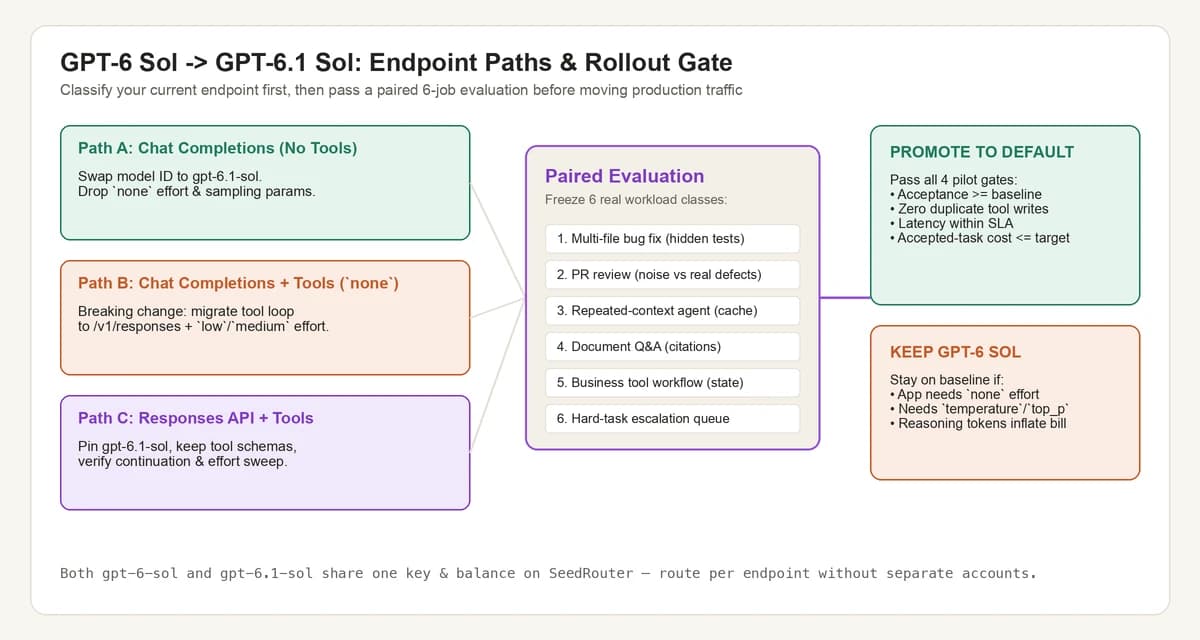
If your current app sits in row two, budget engineering time for the Responses migration first. Testing a new model at the exact same time you rewrite tool serialization blurs whether a regression came from the model or the client loop.
The cache-read discount is smaller than a whole-job discount
OpenAI's Standard list prices per million tokens for prompts up to 272K input tokens, checked on November 23, 2026 on the OpenAI pricing page:
| Model | Fresh input | Cached input | Cache write | Output (incl. reasoning) |
|---|---|---|---|---|
| GPT-6 Sol | $2.00 | $0.20 | $2.50 | $10.00 |
| GPT-6.1 Sol | $2.00 | $0.10 | $2.50 | $10.00 |
Above 272K input tokens, both models bill the entire request at 2x input and cache rates and 1.5x output. The live rates your SeedRouter account pays are read directly from billing:
GPT-6 Sol
GPT-6 Sol is billed per token. Prices below are USD per 1M tokens for each available group, read live from the current billing configuration.
Model ID: gpt-6-sol.
| Category | gpt-0.1 | gpt-0.7 | gpt |
|---|---|---|---|
| Input | $0.20 | $1.40 | $0.20 |
| Output | $1.00 | $7.00 | $1.00 |
| Cached input | $0.02 | $0.14 | $0.02 |
| Cache write | $0.25 | $1.75 | $0.25 |
| Input, over 272K | $0.40 | $2.80 | $0.40 |
| Output, over 272K | $1.50 | $10.50 | $1.50 |
| Cached input, over 272K | $0.04 | $0.28 | $0.04 |
| Cache write, over 272K | $0.50 | $3.50 | $0.50 |
Cached input and cache writes are part of total input; subtract them before applying the uncached input rate. When context tiers are shown, the full prompt selects the tier for the whole request.
Cost is the sum of each billable token category multiplied by its rate, divided by 1,000,000. Use the rates of the selected group and applicable tier. A request that fails is not charged.
GPT-6.1 Sol
GPT-6.1 Sol is billed per token. Prices below are USD per 1M tokens for each available group, read live from the current billing configuration.
Model ID: gpt-6.1-sol.
| Category | gpt-0.7 | gpt | gpt-0.1 |
|---|---|---|---|
| Input | $1.40 | $0.20 | $0.20 |
| Output | $7.00 | $1.00 | $1.00 |
| Cached input | $0.07 | $0.01 | $0.01 |
| Cache write | $1.75 | $0.25 | $0.25 |
| Input, over 272K | $2.80 | $0.40 | $0.40 |
| Output, over 272K | $10.50 | $1.50 | $1.50 |
| Cached input, over 272K | $0.14 | $0.02 | $0.02 |
| Cache write, over 272K | $3.50 | $0.50 | $0.50 |
Cached input and cache writes are part of total input; subtract them before applying the uncached input rate. When context tiers are shown, the full prompt selects the tier for the whole request.
Cost is the sum of each billable token category multiplied by its rate, divided by 1,000,000. Use the rates of the selected group and applicable tier. A request that fails is not charged.
Because cached input is already much cheaper than output, halving the cache-read line moves total job cost far less than headlines imply. Consider a workload with 1,000,000 total input tokens and 100,000 output tokens (including reasoning) at OpenAI list rates, holding token counts identical:
| Cached input share | GPT-6 Sol cost | GPT-6.1 Sol cost | Dollar saving | Percent saving |
|---|---|---|---|---|
| 0% cached | $2.00 input + $1.00 output = $3.00 | $2.00 input + $1.00 output = $3.00 | $0.00 | 0% |
| 40% cached | $1.20 fresh + $0.08 cached + $1.00 output = $2.28 | $1.20 fresh + $0.04 cached + $1.00 output = $2.24 | $0.04 | 1.8% |
| 90% cached | $0.20 fresh + $0.18 cached + $1.00 output = $1.38 | $0.20 fresh + $0.09 cached + $1.00 output = $1.29 | $0.09 | 6.5% |
Those numbers assume identical output tokens and zero extra retries. If GPT-6.1 Sol emits even 10,000 extra reasoning tokens on the 90%-cached case ($0.10 of output), the entire $0.09 cache saving disappears. Conversely, if GPT-6.1 Sol resolves a task cleanly without a retry or human repair pass, the real savings dwarf the cache line. Measure both effects instead of calling a winner from the pricing table alone.
Build a paired evaluation around six real jobs
Freeze recent tasks, repository commits and acceptance rules before running either model. Include historical cases where GPT-6 Sol failed or needed manual cleanup alongside ordinary traffic. Keep tool permissions and retry caps identical across both runs:
| Job class | Input and expected result | Acceptance signal | Cost or failure signal | Trial priority |
|---|---|---|---|---|
| Multi-file bug fix | Fixed commit + issue description -> patch | Hidden and visible tests pass without unrelated edits | Retries, broken imports and reviewer cleanup | Start here if Sol struggles on complex diffs |
| PR review | Fixed diff + repo conventions -> defect list | Confirmed defects with tolerable false positives | Engineering minutes wasted chasing false alarms | Stay on baseline if extra findings add noise |
| Repeated-context agent | Large cached prefix + allowed tools -> completed run | Constraints retained; no duplicate side effects | Cache read/write ratio and reasoning output | High priority when billing shows >60% cache reads |
| Document Q&A | Multi-table docs + questions -> cited answers | Exact fields and traceable source quotes | Unsupported claims and manual fact-checking | Test conflicting clauses, not easy lookups |
| Business tool workflow | Goal + sandbox APIs -> expected final DB state | Correct call sequence and clean final records | Duplicate writes or mismatched tool call IDs | Verify the Responses tool loop before scoring quality |
| Difficult-task escalation | Mixed production queue -> accepted outputs | Queue-wide pass threshold met within budget | Combined baseline + escalation spend | Trial a dedicated hard-task route before full cutover |
Define hard rejection rules before launching the run. A business workflow should fail immediately on any duplicate write even if the final text summary looks polished. A code patch should pass hidden regression tests, not only the test file the agent could read. Valid JSON syntax alone never proves extracted fields are accurate.
Log nine fields for every attempt: task_id, model, endpoint, effort, tool_calls, usage (fresh input, cached input, cache write, reasoning output, visible output), retries, accepted (boolean), and review_minutes. Inspect individual tail failures alongside averages, because one runaway loop can skew a small 20-task pilot.
Compare accepted-task cost, then stage the switch
Use one consistent unit metric for both models:
Accepted-task cost = (API token charges + tool charges + human review cost) ÷ accepted tasks
Keep human review time explicit: either price it at a fixed internal hourly rate or report review minutes right next to API spend. Dropping review minutes from one column makes a noisy, cheap model look artificially attractive.
A complete 100-task accounting example
All four columns below are illustrative assumptions on the same 100-task queue (every request inside the standard ≤272K input band, OpenAI list token rates, assumed sandbox tool fees, and human review priced at $30/hour). Token totals include initial attempts, retries and failed runs:
| Metric (100-task queue) | GPT-6 Sol baseline | 6.1 Sol: cache savings only | 6.1 Sol: less rework | 6.1 Sol: more output & retries |
|---|---|---|---|---|
| Fresh input / cached reads (M tokens) | 4.0 / 6.0 | 4.0 / 6.0 | 3.6 / 5.4 | 4.8 / 7.2 |
| Cache writes / output (M tokens) | 0.4 / 1.0 | 0.4 / 1.0 | 0.36 / 0.9 | 0.48 / 1.8 |
| Additional retry attempts | 20 | 20 | 10 | 30 |
| Token charges (OpenAI list rates) | $20.20 | $19.60 | $17.64 | $29.52 |
| Assumed tool charges | $3.00 | $3.00 | $2.70 | $3.60 |
| Human review minutes / cost ($30/hr) | 240 min / $120.00 | 240 min / $120.00 | 180 min / $90.00 | 300 min / $150.00 |
| Total queue cost | $143.20 | $142.60 | $110.34 | $183.12 |
| Accepted tasks (out of 100) | 80 | 80 | 90 | 75 |
| Cost per accepted task | $1.79 | $1.78 | $1.23 | $2.44 |
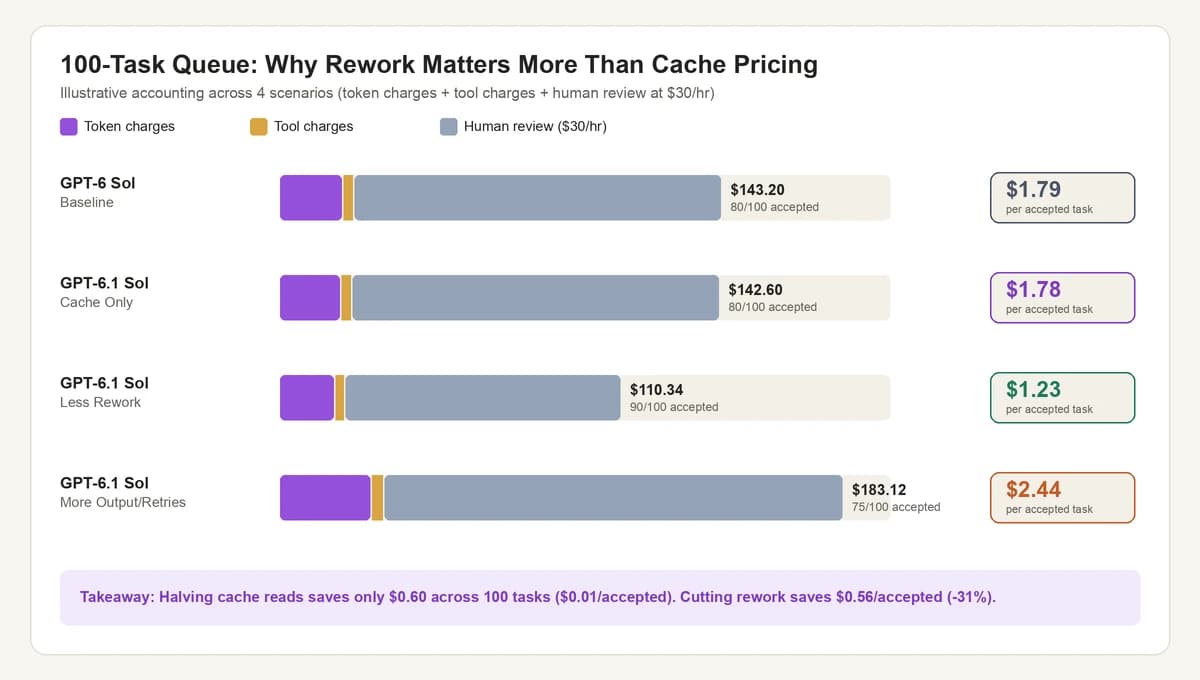
Check the math on the baseline row: 4.0 × $2.00 + 6.0 × $0.20 + 0.4 × $2.50 + 1.0 × $10.00 = $20.20. Adding $3.00 in tool charges and $120.00 in review gives $143.20 ÷ 80 = $1.79 per accepted task.
Look at what separates the three GPT-6.1 Sol outcomes:
- Cache savings alone (
$1.78vs$1.79): saves just $0.60 across 100 tasks, barely a rounding error. - Less rework (
$1.23vs$1.79): raising acceptance from 80 to 90 tasks and trimming retries from 20 to 10 cuts cost per accepted task by 31%, mostly by saving a full hour of human review. - Extra output and retries (
$2.44vs$1.79): if droppingnoneeffort or misconfigured tool loops inflate reasoning output to 1.8M tokens and push acceptance down to 75, unit cost jumps 36%.
Set the pilot gate before running the candidate
Write your promotion criteria before looking at the results so you do not rationalize a mixed run:
- Acceptance gate: candidate pass rate is equal to or higher than GPT-6 Sol on the frozen set, with zero new critical defects or duplicate tool writes.
- Contract gate: every tool call, structured output schema and multi-turn continuation passes under
/v1/responses. - Latency gate: p95 time-to-completion stays inside your user or job timeout SLA at the chosen effort level.
- Unit-cost gate: accepted-task cost beats or matches baseline once retries and review minutes are counted.
Roll out to 10–20% of traffic on one non-critical route first, keep gpt-6-sol pinned behind a config flag for instant rollback, and expand only after a week of clean production metrics. For effort tuning details during that pilot, see our GPT-6.1 Sol reasoning effort guide and GPT-6.1 Sol pricing breakdown.
When keeping GPT-6 Sol is the better decision
Staying on gpt-6-sol is the right engineering call when:
- Your pipeline depends on
reasoning.effort = "none"for fast, non-thinking extraction or requirestemperature/top_psampling controls. - Your tool-calling stack is deeply coupled to Chat Completions and migrating to
/v1/responsesis not worth the sprint cost right now. - Your paired six-job test shows no pass-rate gain while reasoning tokens or latency increase on routine traffic.
Because GPT-6 Sol and GPT-6.1 Sol share one API key and one pay-as-you-go balance on SeedRouter, you do not have to make an all-or-nothing switch: route complex coding and Responses-based agent loops to gpt-6.1-sol while keeping legacy low-latency endpoints on gpt-6-sol.
Common upgrade blockers before cutover
Is GPT-6.1 Sol cheaper than GPT-6 Sol?
Only on cached input reads, where OpenAI's list price drops from $0.20 to $0.10 per million tokens. Fresh input ($2.00), cache writes ($2.50) and output ($10.00) are unchanged. Whole-job savings depend primarily on whether 6.1 Sol cuts retries and human rework, not on the cache line alone.
Can I upgrade by changing only the model ID?
Only if your existing code does not use none reasoning effort, does not pass temperature or top_p, and does not run function calling on Chat Completions. If your app uses any of those, update the client configuration and move tool loops to /v1/responses before switching.
Does GPT-6.1 Sol support none reasoning effort?
No. GPT-6.1 Sol accepts low, medium, high, xhigh and max. Passing none is rejected; if you need zero-reasoning mode or sampling controls, stay on GPT-6 Sol.
Does GPT-6.1 Sol have a larger context window than GPT-6 Sol?
No. Both models share a 1,050,000-token context window, a 128,000-token maximum output limit, and the same 272K long-context billing threshold.
What is the most useful metric for deciding whether to upgrade?
Cost per accepted task: API token spend, tool fees, and human review time combined, divided by the number of tasks that pass your acceptance tests. Comparing headline per-million token rates or cache discounts alone misses rework and reasoning-token drift.
When should I test GPT-6 Astra instead of GPT-6.1 Sol?
If critical tasks still fail on GPT-6.1 Sol at high or max effort, evaluate GPT-6 Astra on a dedicated escalation queue. See our GPT-6.1 Sol vs GPT-6 Astra comparison for where the higher tier justifies its cost.