
Business data analysis with numbers you can trace
Watch the case videoTurn everyday business questions into a clear metric, a checked query and an explanation of the result. Build business data analysis with SeedRouter’s text APIs while your data systems perform the calculations.
For analytics teams and developers connecting natural language to business data.
What business data analysis should make clear
Business data analysis turns operational records into answers that support decisions. SeedRouter supplies text models to interpret questions and explain returned results; your application defines metrics, controls data access and executes approved calculations.
Business data analysis with an agreed metric
Use business data analysis to clarify whether “sales” means orders, gross revenue or net revenue after refunds. Name the metric before generating a query so different wording does not quietly change what the answer measures.
Explore this use caseBusiness data analysis with an inspectable query
Keep business data analysis connected to the tables, joins and time filters used. A query that executes successfully may still count duplicated orders or use the wrong date, so show its assumptions alongside the result.
Explore this use caseBusiness data analysis with grounded explanations
Give business data analysis the verified result table and ask for a concise interpretation. The narrative should retain units, reporting period and exclusions rather than adding a plausible trend or causal story that the data does not establish.
Explore this use case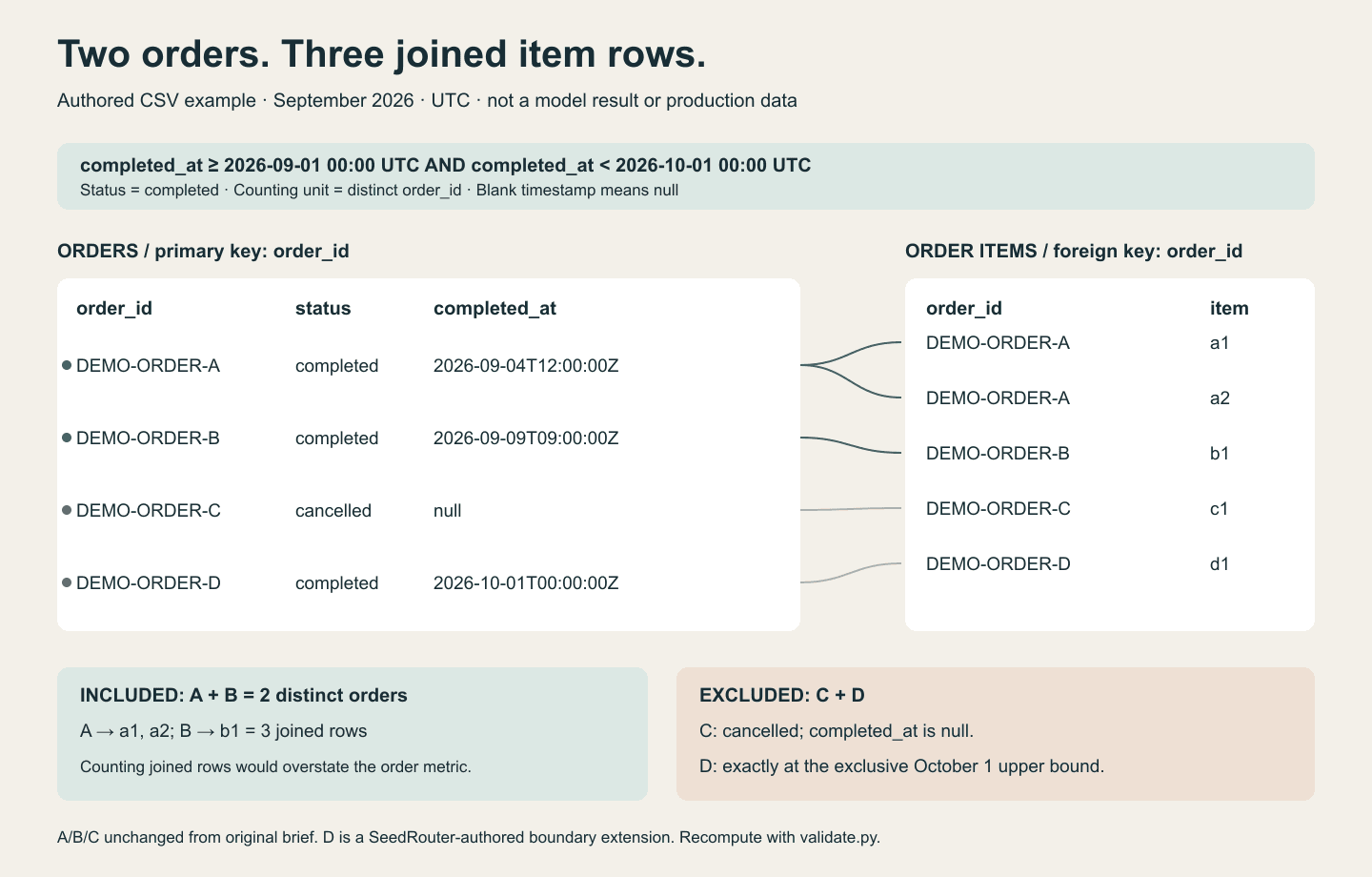
Agree on the metric before asking for the number
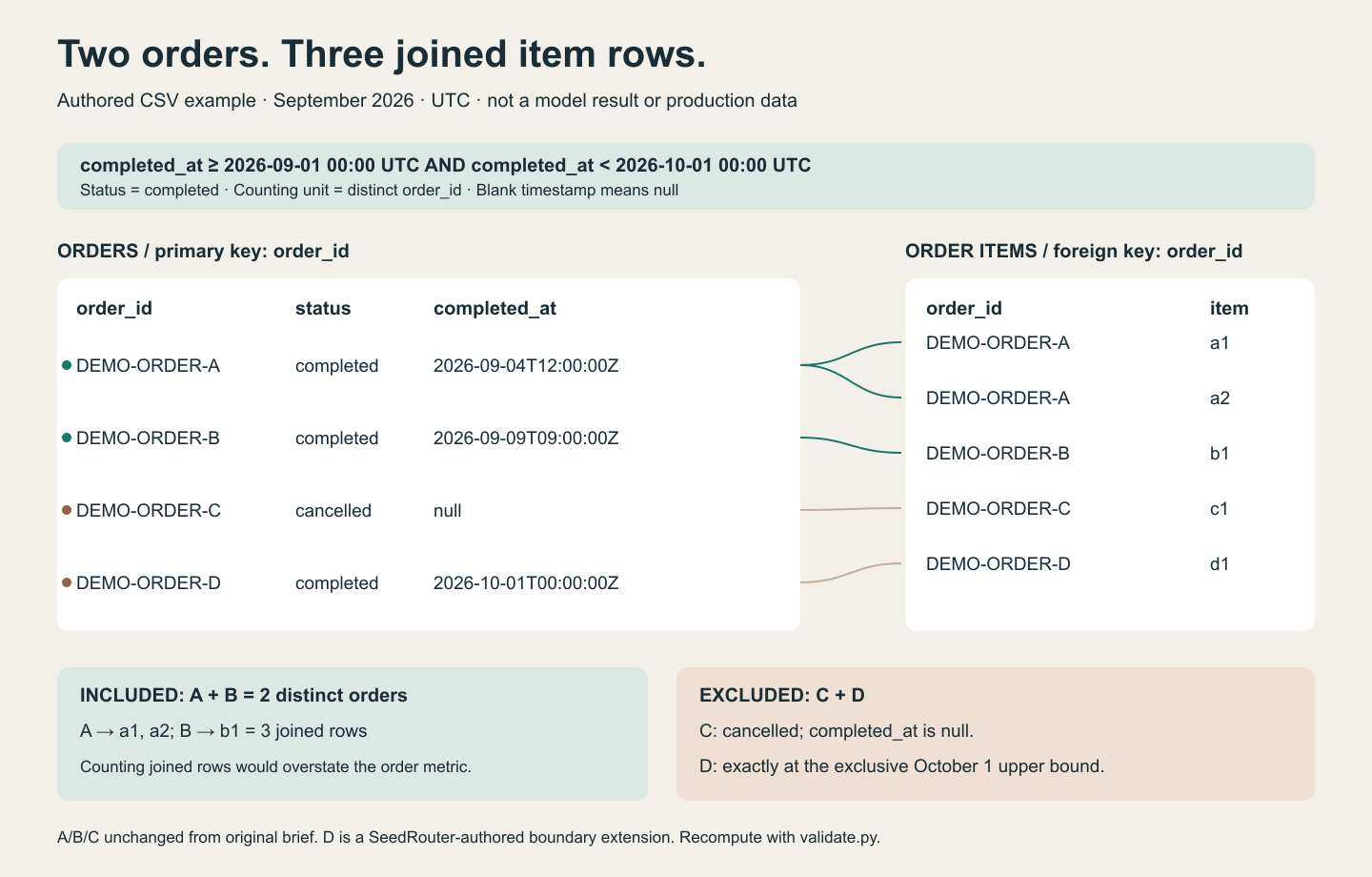
Start business data analysis with a small metric contract. For completed orders, specify the status, counting unit and completion timestamp; a shipment count or order-creation date would answer a different question.
- Define business data analysis denominators for percentages and averages.
- Keep business data analysis aligned with your existing reporting definitions.
- Ask for clarification when the requested metric is ambiguous.
Business data analysis: a metric contract
- Counting unit
- One distinct order_id
- Qualifying state
- completed
- Date field
- completed_at
- Excluded
- Cancelled orders
- Join rule
- Do not duplicate orders through item rows
These definitions are an illustrative business choice; your organization may use different reporting rules.
Make business data analysis calculations repeatable
Business data analysis should preserve the query and the returned table together. Let your database or calculation code produce the numbers, then compare them with a reference calculation before asking a model to explain the result.
- Use approved read-only access for business data analysis.
- Test business data analysis with duplicate joins and empty results.
- Keep time zones and boundary dates explicit in the saved query brief.
Business data analysis · September sample
| Order | Status | Item rows |
|---|---|---|
| DEMO-ORDER-A | Completed | a1a2 |
| DEMO-ORDER-B | Completed | b1 |
| DEMO-ORDER-C | Cancelled | c1 |
2
distinct completed orders
3
completed-order item rows
Business data analysis must keep the counting unit: two items in order A still belong to one order.
Business data analysis without changing the meaning
Use the business data analysis fixture to check whether an answer preserves the metric and its limits. “Two completed orders” is supported by this sample; a claim that a campaign caused growth is not.
- Carry the reporting period into business data analysis answers.
- Give business data analysis only the result detail the reader is allowed to see.
- Separate an observed change from a proposed explanation for that change.
Business data analysis: keep the working attached
- Statement
- 2 distinct completed orders in the sample
- Basis
- DEMO-ORDER-A and DEMO-ORDER-B
- Excluded
- DEMO-ORDER-C is cancelled
- No evidence for
- Revenue, growth rate or campaign impact
The sample supports a count only; further questions need additional data and definitions.
Choose a business data analysis approach
Fit business data analysis to the question and the existing data system. A model can help with language and explanations, while established calculations often need no generative step.
| Question type | Starting point | What stays authoritative |
|---|---|---|
| Business data analysis for a fixed KPI | Existing metric query or report | Your approved metric definition. |
| Business data analysis for a new question | Text model plus query review | Validated query and database result. |
| Business data analysis for commentary | Model supplied with verified results | Returned numbers, units and exclusions. |
From a question to a checked answer
Build business data analysis around one metric that an analyst can verify. Save the question, calculation and explanation together so disagreements can be traced to a specific assumption.
- 1
Name the metric
Give business data analysis the permitted schema and definitions for the task. Resolve the date range, time zone and counting unit before preparing a query.
- 2
Validate and calculate
Review business data analysis queries through your application’s rules. Execute approved read-only work and compare the returned values with a known reference for the test dataset.
- 3
Explain and retain the evidence
Ask business data analysis for a short answer grounded in the calculated result. Keep the query and exclusions available so the reader can reproduce the number.
Business data analysis questions
Can business data analysis answer questions without SQL?
The reader can ask a question in ordinary language, but a data system still needs to perform the calculation. Business data analysis may map that request to an existing metric or a reviewed query; SeedRouter does not invent or retrieve your company’s numbers without supplied data.
Can the model query my database directly?
Your application decides which tools and data access, if any, to provide. For business data analysis, use read-only permissions, allowed tables and bounded execution; generating a query does not grant the model permission to execute arbitrary database operations.
Why can a valid query produce a wrong answer?
It may join rows twice, count the wrong unit or apply the wrong period. Test business data analysis against an analyst’s reference calculation, including cancelled records and one-to-many joins, because successful execution establishes syntax and access rather than business correctness.
How do I keep metric definitions consistent?
Store approved definitions in your data or semantic layer and supply the relevant ones with the question. Business data analysis should reuse those definitions instead of deciding anew whether revenue includes refunds, which date counts or what qualifies as an active customer.
Can this explain why a metric changed?
It can summarize supplied evidence and propose questions to investigate. Business data analysis should distinguish an observed difference from a causal claim; a result table showing fewer orders does not establish whether pricing, seasonality or a campaign caused that change.
How do I estimate cost and data suitability?
Use actual schema and result sizes with current model rates, and measure database work separately. Before using business data analysis through a hosted API, confirm which data may be processed externally and supply only the approved detail needed for the question.
Inspect the metric and reproduce the sample count
SeedRouter prepared this business data analysis example and checked its CSV files locally. A and B yield two distinct completed orders but three joined item rows; C and D are excluded. The script also checks identifiers and dates. No database query or model call produced these results.
- Download the business data analysis fixture
- Source orders CSV
- Source order items CSV
- Run the count and boundary checks
- Inspect the calculation receipt
- GPT-6 Sol documentation
- Monthly report workflow
- Current model pricing
Related solutions
- Ecommerce operations
Create reviewable product copy and campaign drafts from approved product and business information.
- Lead classification and handoff
Extract details from incoming leads, review uncertain classifications and hand records to your business systems.
- Customer support workflows
Connect sourced answers to explicitly approved actions in your existing customer systems.
- Invoice and document extraction
Extract invoice fields and line items, then validate quantities, totals and source evidence.
- Internal knowledge assistants
Build answers around retrieved passages, technical terminology and traceable document sources.
- Monthly reports
Combine deterministic spreadsheet processing with model-assisted classification and written analysis.
Start with the number your team already knows
Choose a trusted metric and a small reference dataset. Test business data analysis against the same calculation, then expand the questions only when the answers preserve the definitions your team relies on.