
Energy AI answers with the source still in reach
Watch the case videoDraft explanations of technical material from the passages your application supplies. Build energy AI with SeedRouter text APIs, keeping the document revision, specialist terminology and supporting section visible to the people reviewing the answer.
For technical knowledge teams and application developers.
Where energy AI fits into technical knowledge work
Energy AI can help explain supplied technical documents and organize sourced answers. SeedRouter provides model APIs; your organization controls document access, retrieval and the qualified review needed for professional decisions.
Find the passage that answers the question
Prepare energy AI with relevant excerpts and their source locations. Similar wording alone is not enough if a passage concerns another component, operating condition or document revision.
Explore this use caseKeep specialist terms in context
Give energy AI the glossary and surrounding material for acronyms or formulas. Inspect parsed symbols and tables so the model receives the same meaning a reader sees in the original.
Explore this use caseTrack questions the documents cannot resolve
Use energy AI to identify missing evidence rather than produce a confident guess. Save the unanswered question and the searched sources for the person who maintains the knowledge collection.
Explore this use case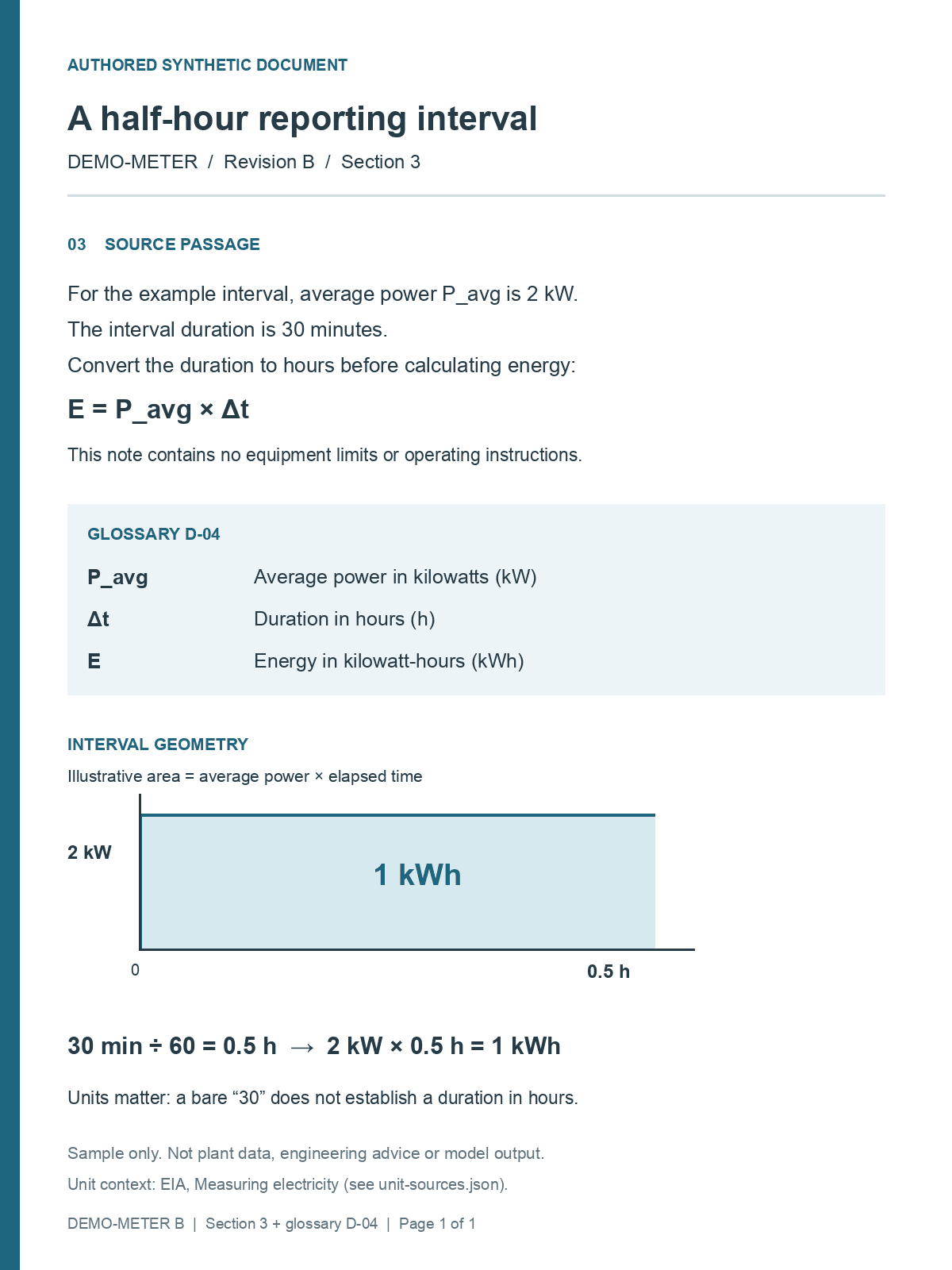
Keep the document revision with every excerpt
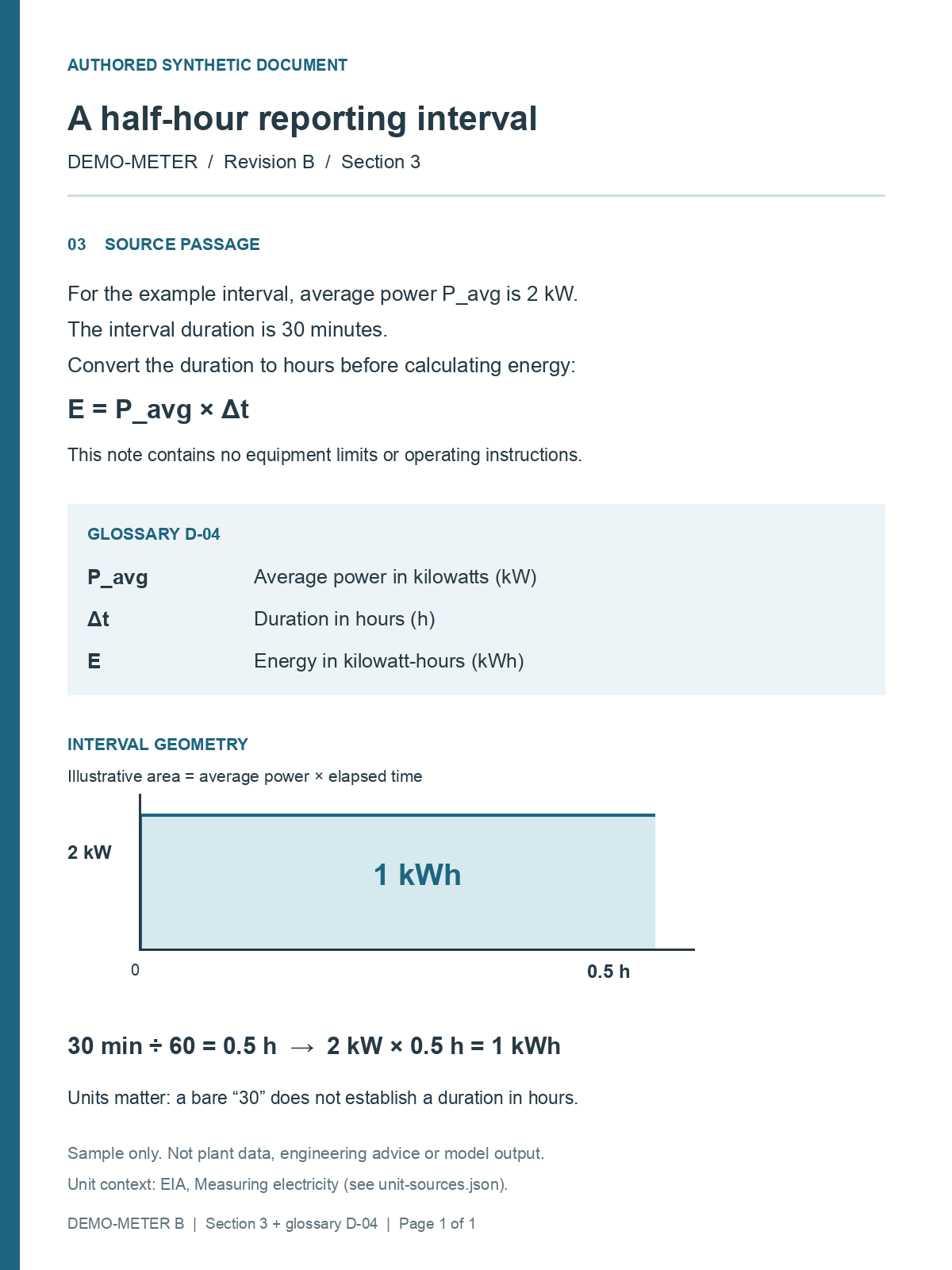
Attach the applicable revision and section to energy AI context. This sample uses DEMO-METER revision B, section 3, and glossary D-04. An excerpt without its unit definitions cannot support the same calculation, even if its numbers were copied correctly.
- Keep original page or section references available.
- Check energy AI answers against the relevant revision.
- Show conflicting sources instead of quietly merging them.
Energy AI source and glossary
- Source
- DEMO-METER · revision B · section 3
- Power / duration
- 2 kW / 30 minutes
- Required glossary
- D-04: power in kW; duration in hours; energy in kWh
- Review boundary
- Source-based explanation; no equipment instructions
Synthetic energy AI document example. It contains no real operating limits or instructions.
Check what the model actually receives
The energy AI sample provides 2 kW over 30 minutes. Converting the duration to 0.5 hours gives 1 kWh. If prepared text loses “minutes,” the value 30 has no usable time unit: request the original passage instead of guessing.
- Compare parsed symbols and units with the original page.
- Provide energy AI with definitions from the relevant glossary.
- Include the referenced section when the excerpt depends on it.
Energy AI · preserve the time unit
DEMO-METER · revision B · section 3
Average power is 2 kW during a 30-minute interval. Convert the duration to hours before calculating energy.
- P_avg
- Average power in kilowatts (kW)
- Δt
- Duration in hours (h)
- E
- Energy in kilowatt-hours (kWh)
E = P_avg × Δt
2 kW × 30 min
30 minutes = 0.5 hours. The source supports this calculation.
Calculation: 2 kW × 0.5 h = 1 kWh
Separate retrieval mistakes from answer mistakes
A larger model cannot explain a section it never receives. Evaluate energy AI by recording the retrieved material, the draft answer and the reviewer’s finding as separate parts of the same test.
- Check whether the required evidence reached the model.
- Keep energy AI citations tied to the actual supplied passage.
- Repeat the same questions when documents or models change.
Energy AI evaluation record
- Question set
- Glossary, cross-reference and revision-conflict cases
- Evidence check
- Was the relevant passage supplied?
- Answer check
- Does each claim follow from that passage?
- Outcome
- Accepted explanation or a specific reason for review
Energy AI evaluation design, not measured accuracy or a claim that changing models fixes retrieval.
Choose energy AI models with representative questions
Use energy AI comparison tasks that reflect the documents your team reads. A general benchmark does not replace checking domain terminology, source support and the cases where the material is incomplete.
| Knowledge task | Starting point | Review focus |
|---|---|---|
| Energy AI explanations | GPT-6 Sol or Claude Opus 5.5 with selected excerpts | Every substantive claim has support in the supplied source. |
| Energy AI terminology | A text model with the approved glossary | Definitions match the relevant component and context. |
| Energy AI evaluation | A fixed question set with reference evidence | Parsing, retrieval and answer errors recorded separately. |
Test a knowledge question from beginning to end
Start energy AI with a small document set and questions a subject reviewer can answer. This makes the source and the expected reasoning inspectable.
- 1
Prepare the material
Give energy AI approved excerpts with revisions and source locations. Check the parsed text, relevant definitions and any referenced sections before requesting an answer.
- 2
Compare the answer
Ask energy AI for an explanation with supporting references and unresolved points. Have a qualified reviewer compare the claims directly with the provided material.
- 3
Record the failure point
Separate energy AI answer errors from missing or incorrectly prepared evidence. Reuse the evaluation set after changes so a better example does not hide a regression elsewhere.
Energy AI questions for technical knowledge teams
Does SeedRouter provide a complete energy AI knowledge system?
SeedRouter provides text model APIs. Your energy AI application still needs document preparation, retrieval, access controls and review, with those components designed around the organization’s actual sources and deployment requirements.
Can energy AI validate an engineering decision?
This workflow supports source-based knowledge work, not engineering certification or equipment control. Energy AI answers require qualified review, and a convincing explanation is not proof that a decision is correct for the operating situation.
Will a bigger context window fix energy AI retrieval?
A larger context window only changes how much input a model can receive. Energy AI still needs the relevant, correctly prepared material; missing sections, incorrect symbols or the wrong revision remain separate problems.
How should energy AI handle formulas and abbreviations?
Supply definitions and the relevant surrounding passage rather than isolated symbols. Check energy AI input against the original document, then review the explanation for units, terminology and applicability before relying on it.
What if energy AI needs offline or restricted deployment?
Confirm the organization’s constraints before selecting a hosted service. This energy AI page does not claim offline operation, a specific hosting region or access to private document systems; those requirements need their own deployment assessment.
How should I compare energy AI models and cost?
Use the same representative questions and excerpts, with a reviewer checking source support. Compare energy AI spending on useful reviewed answers using live rates, and account separately for document preparation, retrieval and specialist review.
Inspect the knowledge brief and supporting guides
SeedRouter authored the energy AI note, glossary and missing-unit example. Its local check converts 30 minutes to 0.5 hours and calculates 1 kWh from 2 kW; when the prepared input loses the time unit, it returns unresolved. These are synthetic materials and deterministic results, not a model benchmark or plant recommendation.
- Energy AI knowledge brief
- Inspect the energy AI source PDF
- Reproduce the energy AI unit check
- See the local unit-check receipt
- EIA: electricity measurement and units
- Knowledge assistant workflow
- Context and output limits
- Current model prices
Related solutions
- Internal knowledge assistants
Build answers around retrieved passages, technical terminology and traceable document sources.
Start with a question and its supporting passage
Choose a technical question your reviewer can verify and prepare the relevant source. Test energy AI on that material, inspect the references and keep unanswered points visible before expanding the collection.